


There’s a hotel in Naples that’s perfect for the night before a flight. In fact, all the United pilots and flight attendants stay there. The hotel is pretty standard and part of a chain, but the building itself is the only “skyscraper” in Naples, which is 24 floors high. As a New Yorker, this is funny to me, but the elevator is a little anxiety-inducing, since Naples is, of course, very prone to earthquakes. But all the rooms have beautiful views, depending on which side of the hotel you’re on: either over the bay of Naples toward elegant Posillipo, or toward the historic center, which I prefer, because it’s a fascinating top-down view of one of the oldest urban grids on earth.
You can see Spaccanapoli, the street that cuts a straight line across the old part of town — spaccare means to split, and the splitter is the original decumanus, the main east-west road of the original Greek city. The city is tightly woven, almost impossibly dense, and what catches my eye are the cloisters: enclosed gardens adjacent to churches, tucked right into the urban fabric. The largest cloister I can see from my hotel window is Santa Chiara, attached to one of Naples’ most historic and beloved churches. It’s a Gothic church built when the city was ruled by the French Angevins, and it has both a monastery and a convent, residences for Franciscan monks and nuns called the Poor Clares, separate, of course. There are still monks and nuns in residence, but in a separate, smaller area, separate from the nuns’ cloister garden, which is a major tourist attraction today for its beautiful majolica tile.
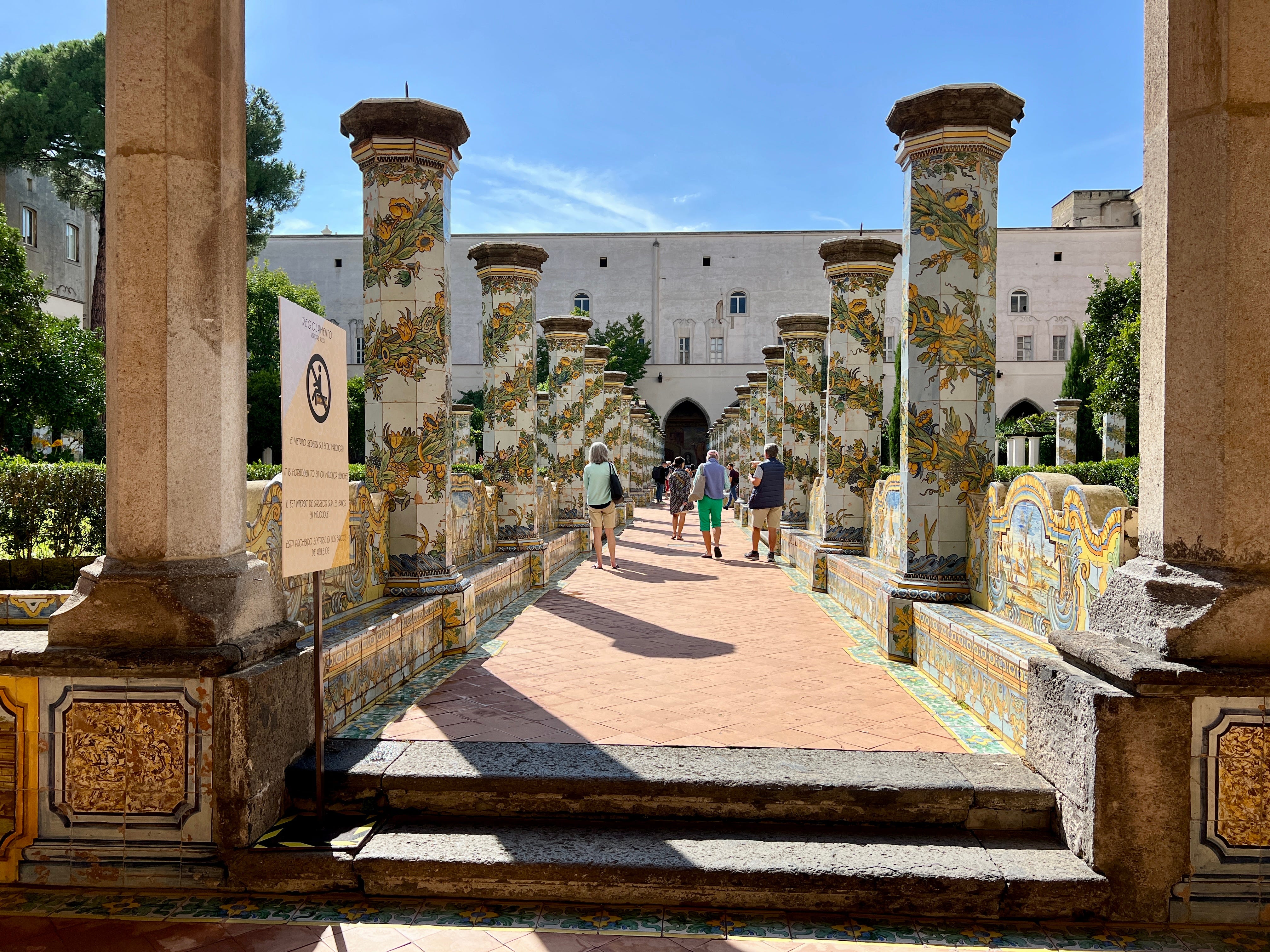
A cloister is an enclosed garden, which comes from the Latin word claustrum, which you will understand immediately if you suffer from claustrophobia, a fear of enclosed spaces. It’s open to the sky, but enclosed on four sides, with gardens designed for some practicalities but also for spiritual contemplation. Frequently, you will find four paths, which form a giant cross, but are also meant to evoke the four rivers of paradise. Also worth noting, the word paradise is a Persian word which means enclosed garden. It was a place of spiritual meditation and prayer. And as an outdoor space, it had practical functions — you can imagine people doing laundry there, getting some exercise, breathing fresh air.
I recognize the cloister not just as a historian, but viscerally, because I spent 16 years working at a museum called The Cloisters, in New York City. The Cloisters is the medieval branch of the Metropolitan Museum of Art, built from pieces of actual French cloisters, and a full apse from Spain that was deconstructed, shipped across the Atlantic, and reconstructed in upper Manhattan. It’s an entirely secular space, but it feels like a spiritual one. I know what it feels like to spend your days inside one of these places, inside an otherwise busy city. It is beautiful and serene, but also isolating and lonely. But I will say this, even on the loneliest days in late January when maybe only 50 visitors would come to the museum, and the staff was bored and mildly depressed and snipping at each other, and the sky was gray, and the gardens were dead, the space always felt privileged.
Who took monastic vows and why
For centuries, specifically in the centuries we label as the Middle Ages and the Renaissance, the cloisters of monasteries and convents were full of monks and nuns; today, this is no longer the case. And that’s not necessarily due to a spiritual crisis because most people did not end up in a monastery by calling. Your family put you there, and they had very specific reasons for doing so.
For sons: the eldest inherited the family fortune. Younger sons could work in the family business if there was one, or go into the military or the church. But deliberately placing a son in a monastery could be an act of piety, though it was often political. If he rose to become an abbot or a bishop, he controlled land and credit networks and could leverage political influence that could directly benefit the family.
For daughters, the issue was a dowry. In wealthy Venice, the cost of a dowry for a merchant family quadrupled in the early 16th century. In Rome, dowries climbed steadily over the course of the 1500s, inflation driven by status competition between elite families. In contrast, you could place a daughter in a convent for roughly 20 times less, so for a family with multiple daughters, that was an easy decision. In 16th-century Florence, more than a quarter of women from elite families entered religious institutions. In Venice, some estimates go as high as 60%.
There were metaphysical motivations as well, primarily the issue of purgatory — this temporary state of purification and suffering for souls that aren’t hellbound, but also don’t have the GPA to go straight to heaven. The prayers of the living, especially monastics, people devoted full time to God, without any distractions or opportunities to sin, which would dilute their spiritual intensity, could shorten that time for family in heaven’s waiting room. The more Masses said for the soul existing in purgatory, the more prayers, the more beautiful art and music that the family patronized for the glorification of God, the better. And the family members who lived in the monasteries and convents were like a stock, compounding spiritual interest over a lifetime.
But families didn’t just park their children in a cell and forget about them. They financially supported the community in which they lived and sometimes even funded private apartments. Those from lesser means did physical labor, while the wealthier ones held power. The convent was one of the few places where women could hold power in an official capacity. On the walls of Goleto Abbey, a gorgeous ruin in the countryside near Avellino, there is a fresco of a nun named Scolastica who holds a bishop’s staff, signifying she held that level of status. Goleto Abbey, by the way, is beautiful even if it was almost completely destroyed. It no longer has a roof, but it’s like walking around inside a Gothic skeleton, in the middle of a lush meadow, surrounded by rolling mountains where vineyards produce Aglianico, Falanghina, and Greco di Tufo.
But I am digressing from my point that monasteries and convents are where you find the most beautiful art, architecture, and music, and are an enormous part of Italian culture; in one way or another, you will encounter them on your trip to Italy. Moreover, much of the art in famous museums like the Uffizi was originally made for churches and later displaced. I think that if you’re not already an art lover, viewing art in museums is challenging because you’re totally lacking the context for which the artwork was intended. To understand why those artworks got displaced — and also why so many 5-star hotels in Italy were once convents or monasteries — you have to understand one of the most dramatic cultural ruptures in Italian history.
A Hinge Point in Italian History
When Napoleon Bonaparte crossed the Alps into northern Italy in 1796, he did so with the idea that the Church was an instrument of oppression, that its hoarded wealth belonged to the people, and that the monastic life was a waste of time. In Bologna, Venice, Milan, and Rome, he ordered the suppression of religious orders, and monks and nuns were expelled from their houses so the properties could be seized by the state. It’s also important to remember this was about 65 years before the nation of Italy that we know today was formed, so he was invading a series of kingdoms and papal states, where the church held enormous power.
In Bologna alone, which had a population of about 70,000, there were 70 convents and monasteries. Napoleon’s law gave them six months’ notice: any monastery with fewer than fifteen local members was dissolved immediately. The rest were consolidated, taxed, and stripped. And the artwork was being evicted and stolen simultaneously. Tommaso Puccini, an official of the Uffizi and the Pitti Palace, secretly loaded 75 crates of Florence’s most precious artworks and dispatched them to Sicily on a British frigate, just to keep them out of Napoleon’s hands.
I write pieces like this so you can travel through a story. If you find my work valuable, please consider supporting it with a paid subscription.
He didn’t save everything. Napoleon’s commissars moved systematically through Italy’s churches, convents, and palaces, pulling paintings off walls and loading them onto wagons headed for Paris. A significant part of the Louvre was built on this confiscation. If you’ve visited the Louvre and been surprised by the endless galleries of Italian Renaissance masterpieces, they are there in large part because Napoleon took them. The masterpieces that didn’t go to Paris were concentrated into newly created civic museums in Italian cities.
The most significant was the Pinacoteca di Brera in Milan, called by Napoleon the “Italian Louvre,” and it was filled almost entirely with paintings stripped from churches and convents across northern Italy and Venice in particular. The word pinacoteca means painting gallery.
The Brera doesn’t have the splendor of the Louvre, and it’s not on the tourist radar in the same way as the Uffizi, but if you’re visiting Milan, it’s an incredible museum and a better investment of your time than visiting Leonardo’s Last Supper. Also, the reason it’s so hard to get tickets to see the Last Supper is that it’s in its original place — a convent, where the scene was painted on the wall of the dining room where the nuns ate. Leonardo used oil paint on a dry plaster wall rather than the traditional fresco technique, and the wall opposite the dining room was the kitchen. When the kitchen heated up, the paint began to deteriorate, and the Last Supper has been pretty much a disaster ever since. It’s been repainted many times, and if Leonardo hadn’t been so famous both in his day and after, that painting would have long been gone. Back to the Pinacoteca Brera — it shares a space with the art school, so there are always many art students sketching in the courtyard. And once inside, especially if you took art history in college, it’s just one greatest hit after the other. Because everything here was stripped out of the most beautiful, well-funded churches, convents, and monasteries from across northern Italy. When you consider the extraordinary wealth of the Republic of Venice in particular, and then think about the amount of patronage that produced, you can start to appreciate why any art lover needs to visit the Brera.
After Napoleon fell, the modern nation of Italy was formed in the 1860s, and the new secular Italian state dissolved all remaining religious orders and confiscated their properties. The buildings were converted into schools, courthouses, hospitals, barracks, and prisons, or were simply left vacant.
By the late 19th century, thousands of magnificent medieval and Renaissance buildings — built to last, set in extraordinary landscapes, with thick walls, vaulted ceilings, and large communal spaces — were rotting. At the same time, Italy was experiencing mass emigration, mostly from the South, but not exclusively. People left Liguria and Tuscany for California and Argentina, laying the foundations of the future wine industry in those places. Then, as Italy’s tourism economy grew in the 20th century, these buildings began to be used as hotels. The cells were already the right size for guest rooms. The refectory — where the monks had eaten in silence — was already a dining room. The wine cellar was already a wine cellar, and the cloisters were a perfect courtyard.
Indulge me this one short rant….
Before I share with you a few of the hotels you should know about, indulge me with this little rant. I know a tour operator who has a very quiet “no church” policy on their tours. This person, like Napoleon, I guess, is strongly anti-clerical and believes her clients think churches are boring anyway. And I want to be clear when I say, whatever your personal beliefs are, and those belong to you, and I respect them completely. But if you choose not to visit any churches during your trip to Italy, you may as well not visit Italy at all. Catholicism is a fundamental piece of Italian culture, even today, when most Italians aren’t particularly religious.
And I would apply this idea to visiting any country where faith and religion have shaped the culture. I have covered my head to visit a mosque and removed my shoes to visit a Hindu temple because any space that people have entered for centuries to be in relationship with the metaphysical world is one of the most interesting, meaningful, and potentially transformative opportunities that come with travel. To reject it would be like going to Italy and eating peanut butter and jelly sandwiches in your hotel room because you’re not willing to try Italian food.
Monasteries Turned Five-Star Hotels
Across Italy, in any region, you will find beautiful hotels named Monastero or Convento — because that’s what they were. I have wondered to myself if occupying these spaces is a desecration, but really, no, the wealth and the status were always here too.
The most famous example is probably San Domenico in Taormina, a very swish Four Seasons hotel now famous for having been the set of season 2 of The White Lotus.
Castel Monastero in Tuscany is a social media darling, a 5-star resort created from an 11th-century monastery. It delivers on every Tuscan dream there is, from cypress-lined roads to hot air balloons. The wine cellar has always been epic, both when it was a monastery and now. The property has been enhanced with pools and a spa, and a Michelin-starred restaurant that was run by Gordon Ramsay for several years. And all the marketing copy promises to deliver the tranquility and peace of the original monastic atmosphere.
My dream hotel is the Monastero Santa Rosa on the Amalfi Coast. Fifteen hundred dollars a night is the starting place. It’s on the Amalfi Coast but not near the water. The monks and nuns were not going swimming — and more practically, malaria was an enormous problem at lower elevations. They built high, above where the mosquitoes could reach them. Which means they have the most incredible views, and now there is an extraordinary, Instagram-famous infinity pool. The restaurant is called Il Refettorio — the refectory, where the nuns once ate together in communal silence. It is now a Michelin-starred restaurant.
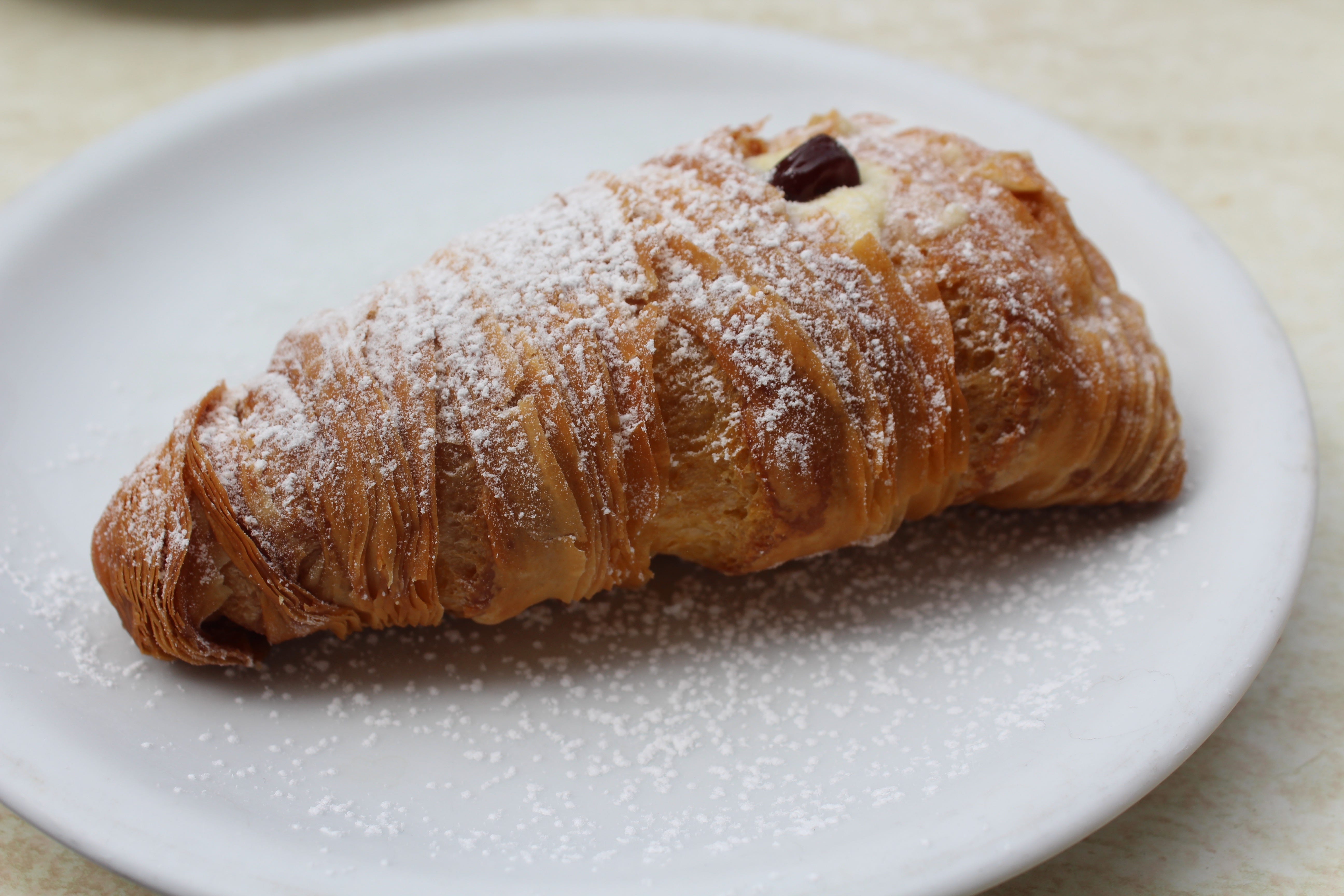
And then there’s the sfogliatella. The shell-shaped pastry filled with ricotta cream — the signature pastry of Naples — has its origin legend at this monastery. If you go to Amalfi, find Andrea Pansa right next to the cathedral, and order the Santa Rosa sfogliatella. It has an amarena cherry in the center.
Life At the Bottom of an Ancient Lake
If you really want to step into this experience and go far off the beaten path, head to Padula. You’ll need to drive through the Cilento National Park — one of the largest protected areas in Italy — past hilltop villages that see almost no foreign tourists. The drive is easy because the population around here is tiny, and there are few people on the highway. Along the way, you’ll notice little hilltop villages that were there 700 years ago when the monastery at Padula was built. And then, on the valley floor, below the village of Padula, you come to the Certosa.
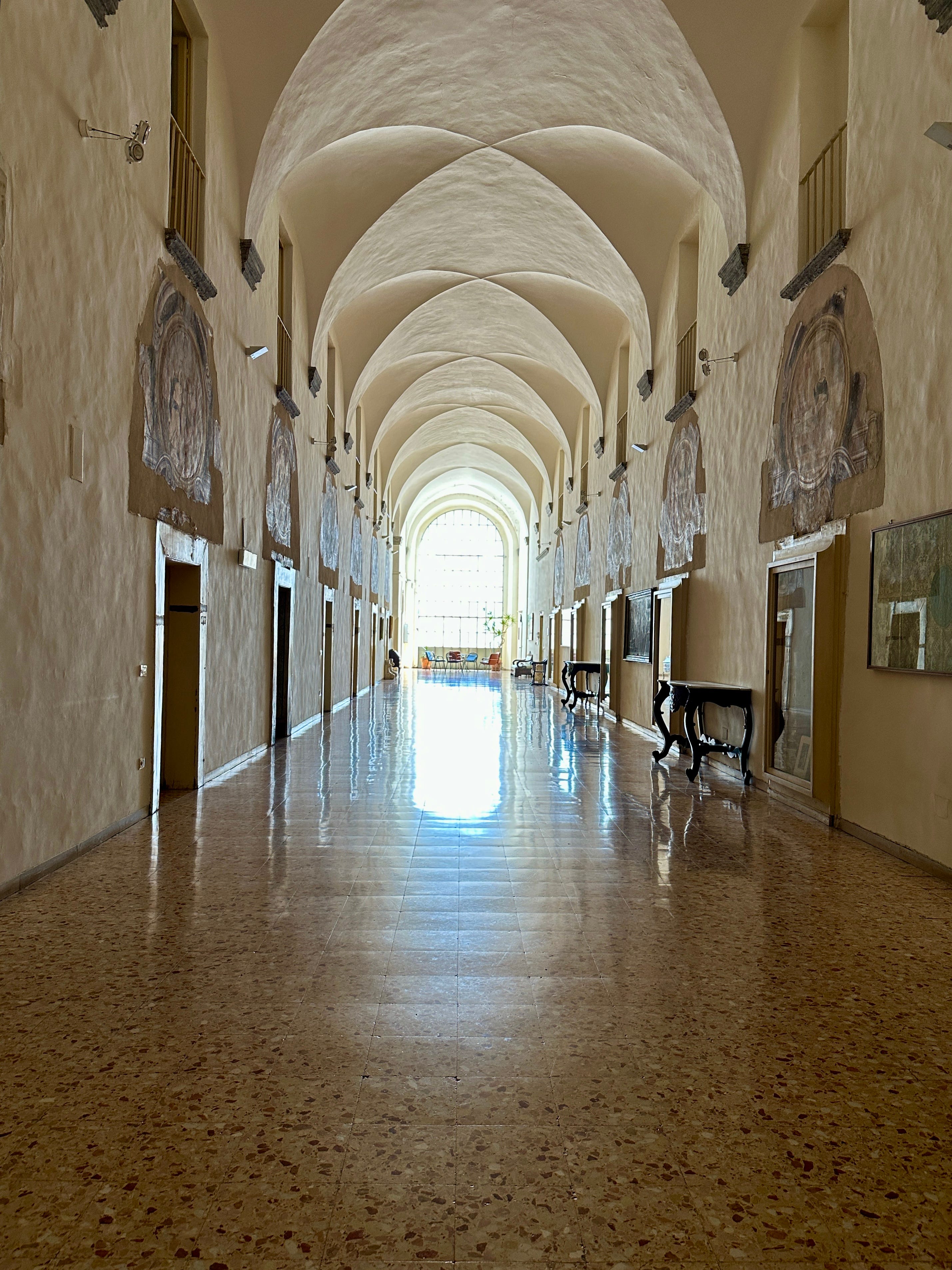
The Certosa di San Lorenzo is the largest monastery in Italy and has the largest cloister in the world. Over 51,500 square meters. 320 rooms and halls. A great cloister measuring 12,000 square meters, ringed by 84 columns. It is magnificent. Also, unless there’s a school bus parked out front, you may very likely be in this enormous space all by yourself.
In 1306, this was not the middle of nowhere, but a critical corridor. It was the main overland route connecting Naples to Puglia to Calabria — an important road that the Romans called the Via Popilia, which had run straight through this valley since the 2nd century BC. If you controlled this area, you also controlled all the movement through southern Italy.
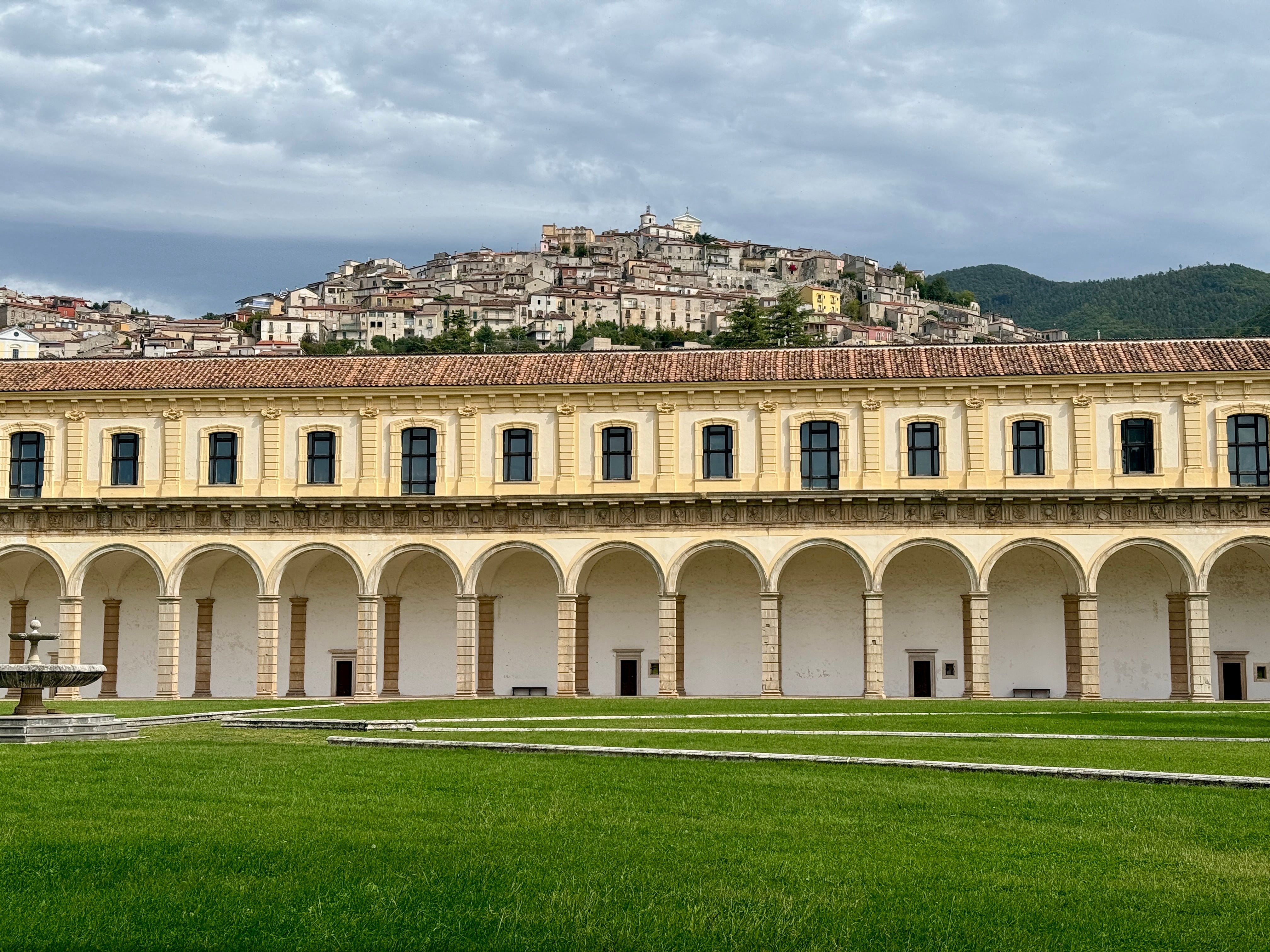
When Tommaso Sanseverino founded the Certosa di Padula in 1306, he deliberately chose the Carthusians. They originated in France, and at that time, the French Angevins ruled from Naples. But more importantly, Carthusian monks would be able to work the land, which at that time was a flooded marsh. The Carthusians’ engineering expertise came directly from their Rule: because each monk lived in complete solitude in his own cell, the order required individual running water to be piped to every cell in every monastery they built, which made hydraulic engineering an institutional skill they carried with them wherever they went. At Padula, that same expertise drained the valley floor — the silted bed of an ancient lake — turning it into some of the most productive agricultural land in the region. The result was that the Certosa became not just a spiritual institution but an economic powerhouse, controlling the farmland, the water, and the road traffic of the entire valley for five centuries.
When Charles V passed through in 1535 on his way back from defeating the Ottoman fleet at Tunis, he stopped here — not because Padula was remote, but because the Certosa was the grandest and best-provisioned stopping point on the entire road through southern Italy. The monks fed his entire army. For the Emperor’s breakfast, they made a frittata with 1,000 eggs. He stayed two days and confirmed the monastery’s privileges in gratitude. Today, every August 10th, the town of Padula still cooks an enormous frittata in the piazza to commemorate the visit.
When Napoleon’s forces suppressed the Certosa in 1807, they stripped five centuries of accumulated wealth: 172 paintings alone were carted to the Royal Museum of Naples — what is now Capodimonte — while manuscripts and documents were absorbed into Neapolitan state archives, and we can assume quite a lot was sold, stolen, damaged, or destroyed. After Napoleon’s fall, the monks briefly returned, but the Italian unification ended monastic life there permanently. The gorgeous structure became a military barracks, then an orphanage for boys, and then a WWI prisoner-of-war camp. What survives at Padula today — the architecture, the elliptical staircase, the ceramic floors — is essentially what was too heavy or too fixed to steal.
But what remains is an extraordinary peace. The fresh air, the pristine landscape. The ability to imagine what a life here was like, quiet, contemplative — the hum of all those monks, all moving in patterns of silence. Then you go up to the village of Padula and look down at the Certosa and across the landscape, and understand that you’re looking at the bottom of an ancient lake that was masterfully engineered by monks 800 years ago.
The monastery is a museum now, formalized in the 1980s, and UNESCO-listed in 1998. There’s a museum of Lucanian art there that’s not often open, and some contemporary art installed, which… is not good. My favorite part to visit is the kitchen, with a great stone fireplace and a copper sink, and beautiful ceramic tile from Vietri sul Mare on the Amalfi Coast. A monumental elliptical marble staircase — a double helix in white stone — leads to the library. It was the last addition to the monastery before Napoleonic suppression.
You can also have lunch in Padula. Just make sure you eat before 2 pm because the whole town shuts down for the afternoon and doesn’t re-open until dinnertime.
Where the Monks Still Pray
Let’s go back to Naples, where we started this episode. Naples has over 600 churches, and many of them are built atop Roman and Greek temples. But I want to walk just a short distance away to San Domenico Maggiore, a church we first visited in Episode 4: Vittoria Colonna Had It All. It was once the most important church in Naples, and I strongly believe it should be better known today. If you remember that episode, the Aragonese kings of Naples are buried there, and after the 1980 earthquake rocked their tombs, their skeletons were studied by paleo-archaeologists, revealing something very surprising that you’ll just have to listen to that episode to learn.
At San Domenico, in the 13th century, a young nobleman named Tommaso first encountered the Dominican friars. Tommaso was the youngest son in his family, whose brothers had gone into military service, while he was to follow in his uncle’s footsteps and become the abbot of Monte Cassino, the great Benedictine monastery near their home in Aquino. But after receiving his early education at the monastery, his family sent him to the university in Naples, where he would discover the Dominicans — a mendicant order of poverty, wanderers, preachers in beggars’ robes — and he decided that was the life he wanted, not the cushy life of a Monte Cassino monk. His mother was so furious, she had him kidnapped and held at the family castle for over a year to talk him out of it. It didn’t work, and he began a long career between Naples, Paris, Rome, and Orvieto, writing many of the most important texts in the Catholic intellectual tradition.
From 1272 to 1274, the man we call St. Thomas Aquinas was given the opportunity to set up a school anywhere he wished, and he chose Naples. He lived in the monastery at San Domenico and wrote the third part of the Summa Theologica — a systematic, comprehensive attempt to reconcile faith and reason and insist that rigorous intellectual inquiry and deep faith are not enemies. And this is why Thomas Aquinas is having a remarkable moment right now.
There is currently a significant wave of conversion to Catholicism underway, and much of it is coming from Silicon Valley. The engineers, philosophers, and venture capitalists grappling with the implications of artificial intelligence are finding that the medieval Church thought deeply about consciousness, personhood, and the nature of intelligence. The Vatican has been hosting conversations with AI leaders, and Thomas Aquinas keeps appearing in those conversations, because he asked the right questions.
You can visit the church of San Domenico for free, but if you pay the extra 10 euros, you can visit the monastery and visit St. Thomas’s cell. There, witnesses reported that they found him before dawn, suspended three feet off the ground in prayer before a crucifix, completely oblivious to the world. A voice reportedly came from the crucifix and asked what reward he wanted; he said, “nothing but you, Lord.” There’s also a reliquary holding a piece of bone that belonged to St. Thomas’s arm, and pilgrims will go there to pray in front of it. There’s also a heart of someone — we don’t know who — but at one point there were the hearts of three different Neapolitan kings, all lost when, you guessed it, Napoleon’s troops suppressed the monastery.
But San Domenico is somehow still active. There are just a few brothers still there, all elderly. If you pass through the monastery to see St. Thomas’s cell, and it’s just before lunchtime, you might smell the pasta al forno — what we call baked ziti.
I pray the monk’s cells at San Domenico never become a hotel. I hope there’s a renaissance of visitors who want to see this beautiful place. Please put it on your itinerary. Go to learn more about it, but also to feel it. I remember my friend Don saying that he didn’t like to go to yoga classes at the gym, that he liked this yoga center on 14th street in New York City, because it had been a yoga studio for decades, and he said places that have been meditated and prayed in for a long time have a sort of patina, a peaceful vibe that facilitates the experience. The monastery cells at San Domenico have been active for 800 years.
That’s why I want you to go to San Domenico.
🗺️ SHOW NOTES & RESOURCES
Everything you need to plan your own visit.
🏨 WHERE TO STAY
NH Napoli Panorama (the hotel at the top of the episode)
Naples’s tallest building — 24 floors — with rooms facing either the Bay of Naples toward Posillipo, or over the historic center toward Spaccanapoli. A practical base for a night before a flight or a first night in the city.
📍 Via Medina 70, Naples
🌐 nh-hotels.com/en/hotel/nh-napoli-panorama
Monastero Santa Rosa Hotel & Spa (my dream hotel)
A 17th-century convent perched on the cliffside above Conca dei Marini on the Amalfi Coast. 20 rooms, an infinity pool carved into the cliff, and the Michelin-starred restaurant Il Refettorio — the nuns’ former dining hall. The spa is the original convent winery. Open April through early November. Starting around $1,500/night. No guests under 16.
📍 Via Roma 2, Conca dei Marini (Amalfi Coast)
📞 +39 089 832 1199
🌐 monasterosantarosa.com
Castel Monastero (Tuscany)
A 5-star resort built within an 11th-century monastery and medieval hamlet in the Chianti hills. 68 rooms and suites, a Michelin-starred restaurant, a wine cellar, hot air balloons, pools, and a spa.
📍 Località Monastero d’Ombrone, Castelnuovo Berardenga, Siena
🌐 castelmonastero.com
San Domenico Palace, Taormina — A Four Seasons Hotel (setting of White Lotus Season 2)
A 14th-century Dominican convent above the Ionian Sea. The original 16th-century cloister is still intact at the heart of the hotel.
📍 Piazza San Domenico 5, Taormina, Sicily
🌐 fourseasons.com/taormina
If you are booking a 5-star hotel, use my advisor network for your reservation and receive perks and upgrades. I earn a 5% commission on your stay. Once you create an account with Classic Travel linked to my advisor account, you can use the same portal to book 5-star hotels anywhere in the world and receive the same benefits.
https://www.classictravel.com/Danielle
Borgo San Gregorio (for visiting Goleto Abbey — Irpinia, Campania)
A wine resort and restaurant in Sorbo Serpico, in the heart of Irpinia, set on the estate of Feudi di San Gregorio winery. 12 rooms with panoramic views of the Irpinian hills, surrounded by vineyards producing Taurasi, Fiano, and Greco di Tufo. Chef Danilo Uva serves traditional Campanian cuisine. About 30 minutes from Goleto Abbey.
📍 Località Cerza Grossa snc, Sorbo Serpico (Avellino)
🌐 borgosangregorio.com
Santa Chiara Boutique Hotel (Naples)
A 4-star boutique hotel right on Spaccanapoli, steps from Santa Chiara and San Domenico Maggiore. An ideal base for this entire episode’s Naples itinerary.
📍 Via Benedetto Croce 23, Naples
🌐 santachiarahotel.com
🏛️ PLACES TO VISIT
Santa Chiara — Cloister, Museum & Basilica (Naples)
The church is free. The majolica cloister and museum (including the Roman baths) cost €6. Open daily 9:30 am–5:30 pm.
📍 Via Santa Chiara 49c, Naples
📞 +39 081 551 6673
🌐 monasterodisantachiara.eu
San Domenico Maggiore (Naples)
Church is free and open daily, 10 am–6pm (closed for lunch, 1:30–2:30 pm, weekdays). The monastery visit — including St. Thomas’s cell, his arm bone reliquary, and the sacristy with the royal tombs — costs approximately €10 and is accessed separately. Check hours in advance as they vary.
📍 Piazza San Domenico Maggiore 8A, Naples
📞 +39 333 863 8997
Abbazia del Goleto (near Sant’Angelo dei Lombardi, Avellino — Irpinia)
A Benedictine abbey founded in 1114, now a magnificent roofless Gothic ruin set in a meadow in the Irpinian hills. Free to visit; the grounds are managed by the local community. Check locally for current access, as hours are informal. About 1.5 hours from Naples. Best combined with a stay at Borgo San Gregorio and a meal at Antica Trattoria di Pietro.
📍 Sant’Angelo dei Lombardi, Province of Avellino
Certosa di San Lorenzo, Padula (the largest monastery in Italy)
Open Wednesday–Monday, 9:00 am–7:30 pm. Closed Tuesdays. Admission €6, reduced €2 for ages 18–25, free under 18. Campania ArteCard accepted. Allow at least 2 hours.
📍 Viale Certosa, Padula (Salerno)
📞 +39 0975 77552
Pinacoteca di Brera (Milan)
Open Tuesday–Sunday, 8:30 am–7:15 pm. Closed Mondays. Admission €20; reduced €4 for ages 18–25; free under 18. Free first Sunday of every month (reservation required). Book at brerabooking.org. Metro: M2 Lanza stop.
📍 Via Brera 28, Milan
📞 +39 02 72105 141
🌐 pinacotecabrera.org
🍽️ WHERE TO EAT
Andrea Pansa (Amalfi)
In business since 1830, right on the cathedral square. Order the Santa Rosa sfogliatella — the original, with the amarena cherry in the center. Open daily 7:30 am–11:00 pm.
📍 Piazza Duomo 40, Amalfi
📞 +39 089 871 065
La Locanda dei Trecento (Padula)
Traditional Cilento cooking. Eat before 2 pm, or the town closes until dinner. Open Thursday–Tuesday 11:30 am–late. Closed Wednesdays.
📍 Via Annunziata, Padula
📞 +39 0975 77680
Antica Trattoria di Pietro (Melito Irpino, Avellino — for visiting Goleto Abbey)
In business since 1934, now in its fourth generation. Slow Food Osterie d’Italia award-winner for best regional Italian cuisine. This is the kind of place where Italian-American visitors have been known to cry at the table because the food tastes like their grandmother’s kitchen. Traditional Irpinian cooking — handmade pasta, cured meats, local cheeses, wood-fired focaccia, and Aglianico from the family’s own vines. Closed Wednesdays and two weeks in September.
📍 Corso Italia 8, Melito Irpino (Avellino)
📞 +39 0825 472010


