



A quick note for paid subscribers: the August Ask Me Anything About Italy will take place on August 13th at 8 pm ET. This month’s Destination Deep Dive will cover Baia, Pompeii, Herculaneum, and Oplontis — the ancient Roman cities around Naples in honor of the new series about Pompeii Out of Time currently streaming on Disney+. We’ll convene here on Substack Live for that on August 27th at 8 pm ET.
Podcast Show Notes: The Fake (Maybe) at the Met
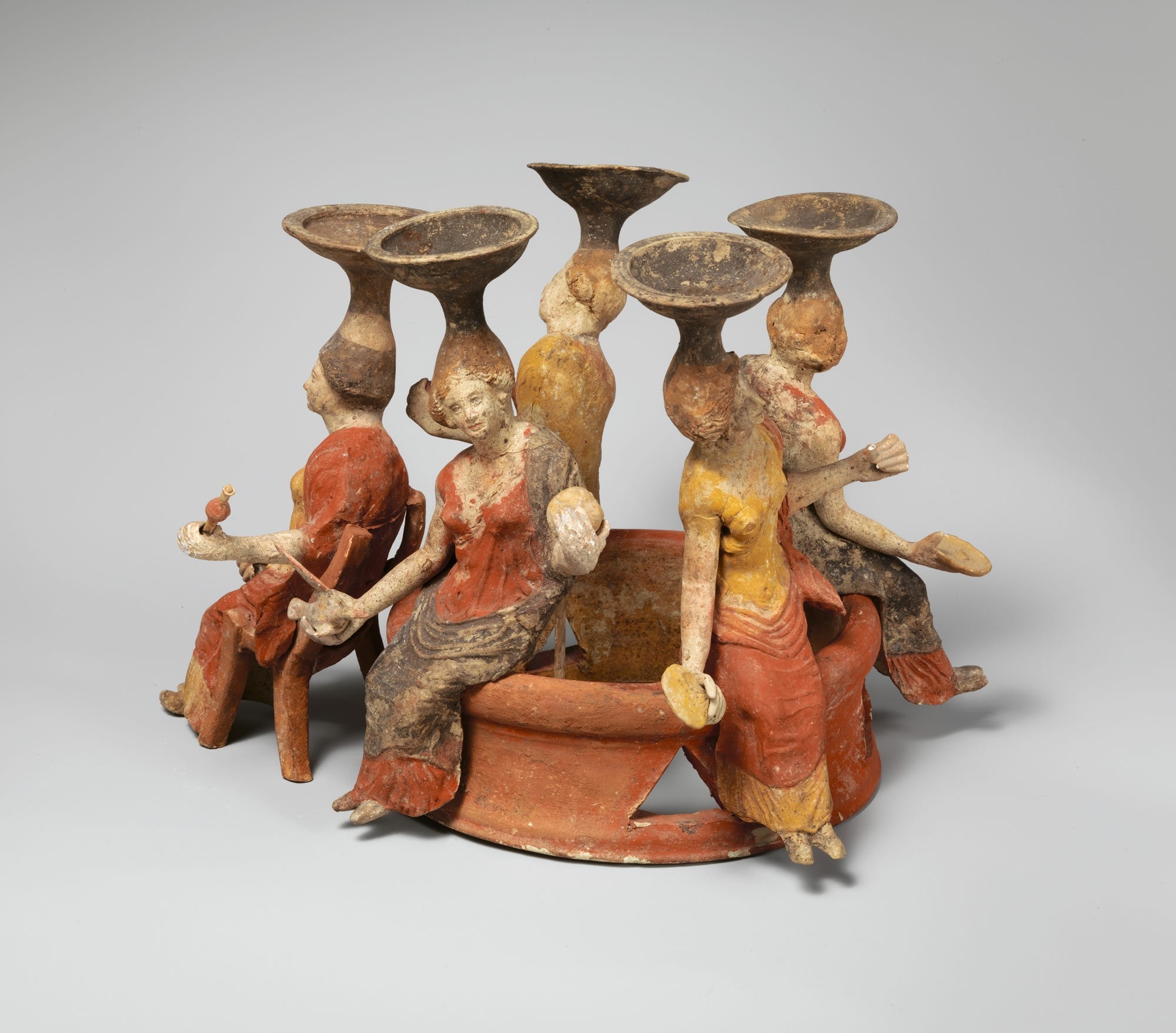
I visited a piece that I absolutely love, but I also think it’s too good to be true. It’s a thymiaterion, an ancient incense burner used for weddings, ceremonies, and funerals, at the Metropolitan Museum of Art: a ring with five figures, each holding a different attribute, like little action figures. I think it could be a pastiche, a mix of something ancient with something modern, if not an outright forgery.
Terracotta group of women seated around a well head
The Instagram post that started it
I posted about it on Instagram, where I wrote: “I love this beautiful thing, but I think it’s a fake. Please prove me wrong.” The post got over 21,000 views and around 110 comments.
The original Instagram post — danielleoteri_italy
Prior owners
Mary Jaharis donated the piece to the Met in 2012. She acquired it at the 1999 Sotheby’s sale of the Christos Bastis collection. Before that, it was on view at the Merrin Gallery in New York until the early eighties.
The Getty’s own former curator of antiquities, Marion True, was put on criminal trial in Italy for conspiring to receive looted antiquities; that trial collapsed in 2010 when the statute of limitations expired. The dealer tied to that network, Giacomo Medici, was convicted in Rome and sentenced to prison. If you’re interested in this topic, I highly recommend “Chasing Aphrodite: The Hunt for Looted Antiquities at the World’s Richest Museum” by Jason Felch and Ralph Frammolino.
Chasing Aphrodite, by Jason Felch and Ralph Frammolino
Also, my apologies to Ralph Frammolino — I mispronounced your name in the recording.
The tombaroli and Taranto
The word for the people who do the tomb robbing is tombaroli. Taranto, in Puglia, is one of the most abused archaeological sites there is; its old city, la città vecchia, is Greek, filled with underground burial chambers that smugglers have used for storage in more recent times.
Museum of Looted Art
I got a message from an Instagram account called Museum of Looted Art, pointing me to their database of documented looted works, specifically the history of the Merrin Gallery. MoLA is a project of Jason Felch, author of Chasing Aphrodite.
The Tanagra connection
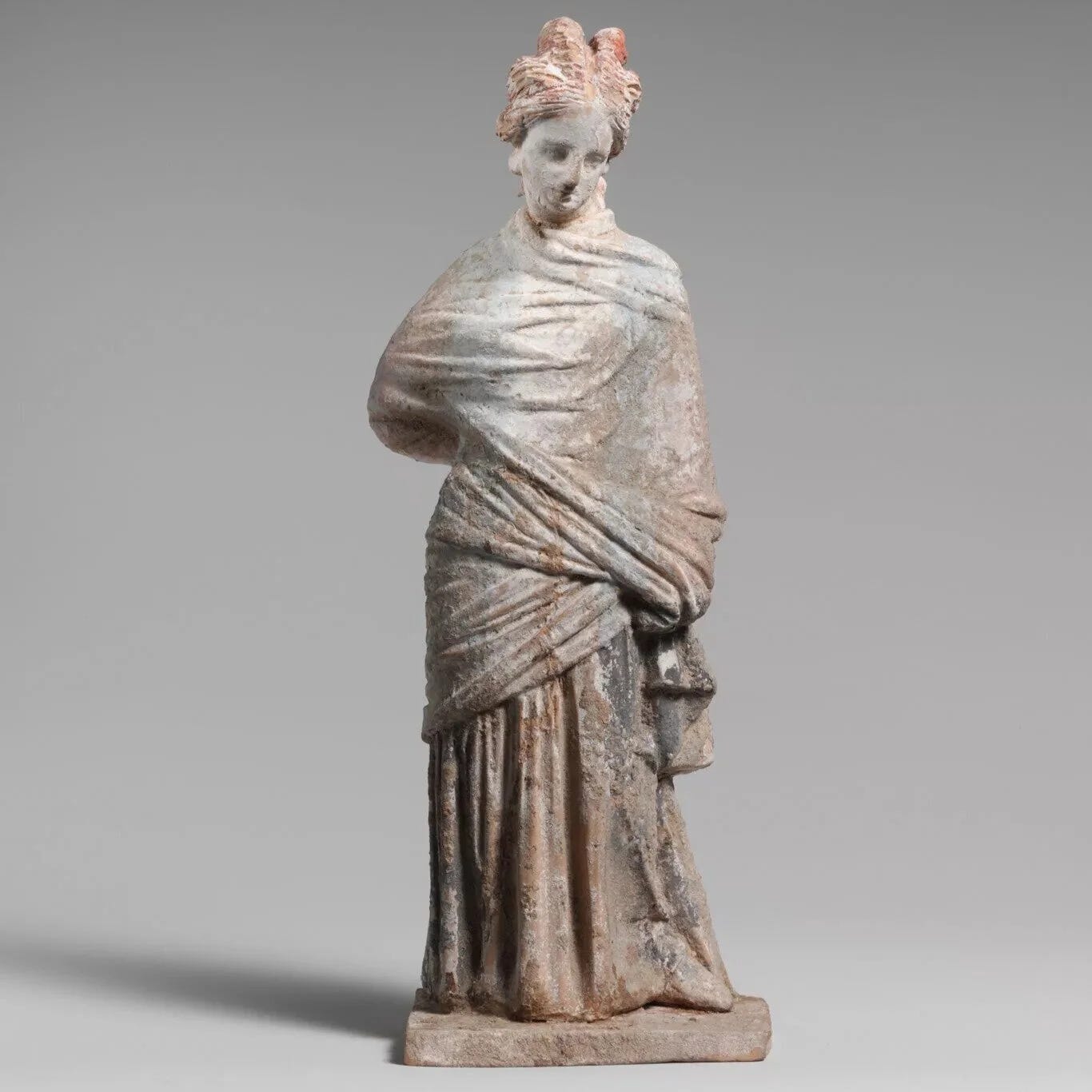
The figures are most closely aligned with those of Tanagra. In the 1860s, hundreds of these terracotta figures were accidentally discovered by farmers plowing their fields. When they first appeared on the French art market around 1871, collectors and artists went wild, calling them the Parisians of Antiquity. They were displayed at the Paris World’s Fair in 1878.
More about Tanagra figures here.
A more recent parallel: the flood of fakes in Islamic art tied to wealthy collectors in Doha, Dubai, and Abu Dhabi since the early 2000s, and the “Salvator Mundi” painting sold at Christie’s in 2017 for $450 million, which I have never for one minute believed was an authentic Leonardo.
Coverage of the Salvator Mundi sale
Paestum
Throughout the Southern Italian Greek colonies, most notably Paestum, you find hundreds, potentially thousands, of terracotta heads with an incense burner, often in the form of a flower, from the sanctuary of Hera. Many are on display in the museum right next to the archaeological park, but none show five women in a composition like this one.
Why testing doesn’t settle it
The main dating tool is thermoluminescence, which measures the energy stored in an object since it was last fired. Forgers can defeat this: carving fakes from genuinely ancient fired material, grinding real ancient ceramic into new clay, or artificially irradiating pieces with X-ray equipment.
Where I landed
I don’t love it quite as much as I did. I still very much want it to be real, but I’m going to trust my initial reaction here and say I don’t believe it. I’m not accusing the Met of anything nefarious; I don’t know the politics behind this object’s display, and I’ll leave open the possibility that the curators have good reason to believe it’s real.
What I hope this episode has done is made you more curious. Let me know what you think in the comments.


