


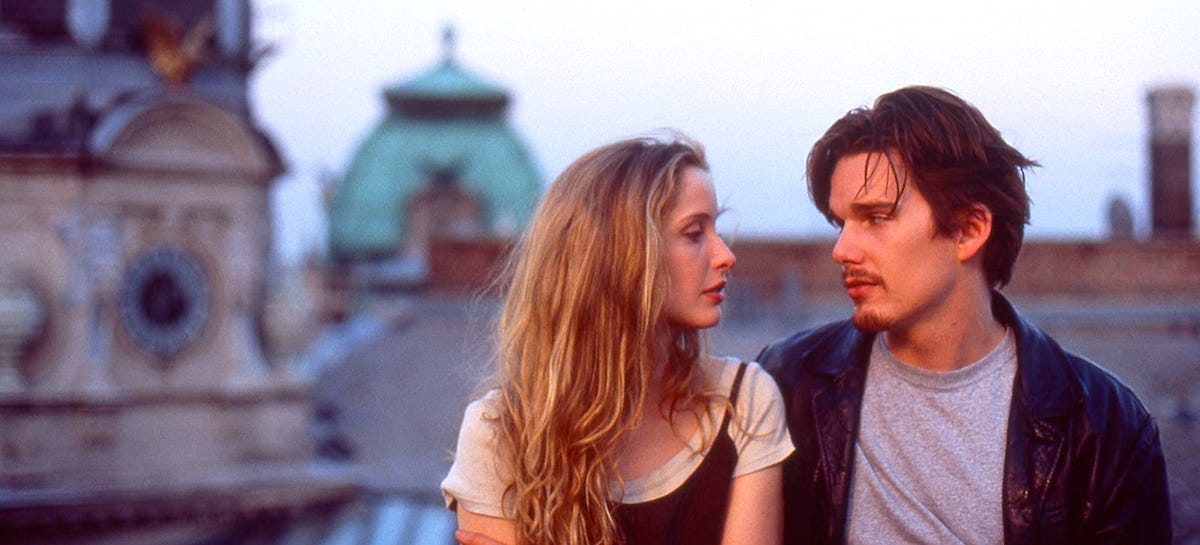
In 1997, I went to Rome with a group of classmates I barely knew. The girls in the group were steering things with the help of the Let’s Go guidebook. We checked into a cheap pensione near the train station, then jumped on the Metro to go see the Colosseum.
Just as we stepped onto the arriving train, I realized we were going in the wrong direction. I yelled at everyone to get out, and they all did, except Matt, who was listening to music from his CD walkman and wasn’t paying attention. The doors closed just as Matt looked up and saw us standing on the platform. We watched his face fall, and his eyes widen as the train slid away into the dark tunnel. The rest of us fell silent for a moment, then burst out laughing because, at that moment, we didn’t know if we’d ever see him again, and there was nothing to do about it. Of course, this story makes no sense to anyone born after 1990 and who never knew life without iPhones, GPS, texting, or social media. But kids… it was glorious. We were free.
I consider myself a member of the “Before Sunrise” generation. The 1995 film by Richard Linklater starred Ethan Hawke as a slouchy aspiring writer and Julie Delpy, a dreamy French student even more beautiful than Carolyn Bessette. They strike up a conversation on a train, then spontaneously decide to get off together and spend the night roaming Vienna with no plan. The movie is just them talking about their hopes, fears, and dreams until they finally fall silent and make love in the park. The next morning, they decide not to exchange phone numbers or addresses, but vow to meet again in exactly one year. Would it happen? The film’s climax was their hopeful embrace of not knowing the answer.
I think I called home twice that month in 1997, only for my mother to ask if I had wiped down the payphone before calling. There was no social media for people to comment on my whereabouts, so if I decided to take the train to Vienna with an interesting guy I had been chatting with, nobody would be tracking my location settings or texting me for updates. When I was waiting for a bus or a train, I either read a book or a magazine or stared at the people around me who were doing the same. I had a few rolls of film with me, but my art student’s Pentax camera was heavy, so I only used it when I set out with the intention to make something. Taking pictures of people back then was mostly done on special occasions or holidays. Nobody knew that within a couple of years, the Internet would change absolutely everything we did, and most of all, us.
The “Before Sunrise” generation has been busy with careers and families, but as their kids leave the nest, a window opens for them to travel again. The world is so much different now, and those old places we saw, like Barcelona or Prague, are very crowded. Instead of an impromptu walk across the Roman Forum, you will need to purchase tickets months ahead with skip-the-line access and pricey upgrades to see things like the underground areas of the Colosseum. The Internet democratized meticulous planning, but it annihilated spontaneity.
In the book If Venice Dies, the author argues that “hit-and-run” tourism is destroying Europe’s cities, and that turning Venice into a shopping mall for tourists is destroying its soul. The Let’s Go guidebook may have funneled young travelers to many of the same places, but that was before cruise ships in Venice's lagoon and Instagram. The impact of tourism is more profound in the era of discount airlines and Airbnb, which made it cheaper to visit a place, but far more expensive to enjoy it.
The solution to the problem of over-tourism is to embrace not-knowing. Stop going to Cinque Terre in the high season, I beg you; the villages are so crowded with tourists, it has become a theme park. Instead, go hiking in Abruzzo, where you have both mountains and sea and arguably the best food in all of Italy. Or the center of Sicily, where the WI-FI is terrible, and you can pretend it’s 1995 and be gloriously out of touch for a few days in the center of the Mediterranean.
Be curious. Explore your obsessions. Reject FOMO. Like another icon of the 1990s, David Foster Wallace said, it “wants your money and does not love you.” Don’t take TikTok travel advice too seriously because it prioritizes the most photogenic places that look good but often feel terrible. Look back at authors you once read and find out where else Hemingway drank. (He drank a lot in Acciaroli, a traditional fishing village on the Cilento Coast. I bet you haven’t been there.) Find new writers, like Chris Arnade, who walk across cities and report on how the world is changing for those outside the power bubbles.
Embrace going to the places not everyone is talking about because spontaneity is now the great luxury. Liberate yourself from the tyranny of choosing the “best thing.” The reward for not-knowing is finding out we’re more connected to each other than we realize. Like when we arrived at the Colosseum, and spotted Matt sitting right there in front of the ticket booth, still listening to his CD Walkman, and waving.
I love this!!! I’m even older, but Before Sunrise is one of my favorite films. I went to Canada and America in the early 80s with my boyfriend with a phone number in my pocket and took a greyhound bus non-stop from NY to Santa Cruz with barely any money.
I met a boy in Florence and we took a train to Venice within an hour so he could show me his favorite place in the world!
Beautiful essay ❤️
This is such a lovely essay, Danielle! Complimenti!
It filled me with nostalgia for my own travels from the Before Times, in Europe and in South America. I still have friendships with people I met back then, and I learned fundamental truths about the world and myself that I still draw from. I loved not worrying about the simple challenge of arriving in some town with no idea where I’d sleep, usually finding a hostel, maybe someone’s couch, or a handful of times under a tree.
I generally embrace new technologies. I like that Substack, for example, exists. That I can write this comment from my neighborhood coffee bar. That I can get my veterinarian’s advice for my dog, Mocha, just by sending a photo of where she scratched herself, or that I can pay rent with a few clicks, or do a television interview from my living room.
But right now I’m having a hard time thinking of a way travel has clearly improved compared to the Before Times.