


This week I’ll be releasing a podcast episode about packing — the perennial question — and I’m going to be very specific, with links to the exact things I put in my suitcase.
To paid subscribers, I’ll be sending you the full notes and resources from the Tuscany Deep Dive on Thursday. And Thursday evening will be the monthly “Ask Me Anything About Italy”.
June’s Destination Deep Dive goes to Ischia. Mark your calendar here.
But now, I want to tell you about the carpet I purchased.
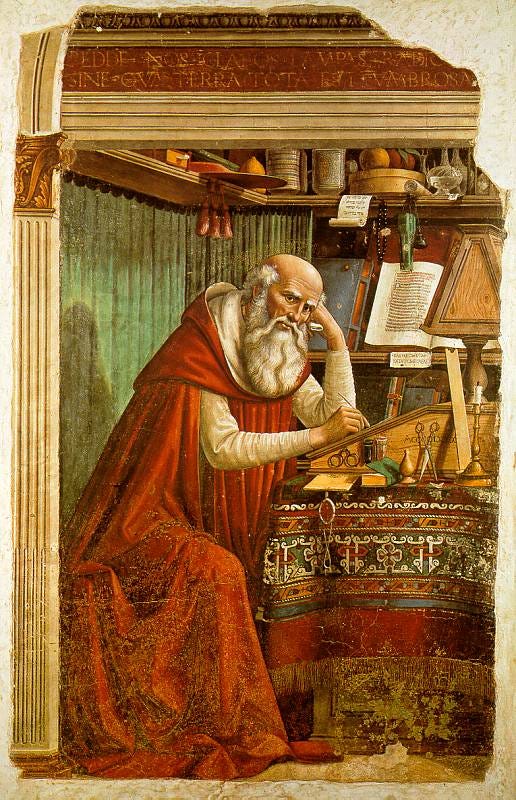
Ever since completing Episode 37: The Secret of Florence’s Dome, I’ve become obsessed with finding Persian carpets in Renaissance paintings. Niche, I know, but what I love most about researching history is how one thing unlocks the other, and sometimes that thing was right under your nose, but no one was giving it any attention, and so neither did you.
For quick context, this episode shares how the knowledge used to build Florence’s famous red dome was transmitted along the Silk Road during the Italian Renaissance. Scholar Lorenzo Vigotti also just published a new article tracing communities of Florentine merchants and monks in the lands that are now Iran, particularly Tabriz, which then and now remains a center of carpet weaving. And when you start looking at Renaissance paintings, not only do you find Persian carpets, but you find them specifically from Tabriz. Like Saint Jerome in His Study, a 15th-century fresco by Domenico Ghirlandaio, in one of Florence’s most important churches.
So of course I became obsessed with buying a Tabriz carpet for my new apartment. If you ever feel Facebook or Instagram is too toxic, start searching for Persian carpets instead. There is a lovely world on social media of people who are well-educated about the many types of carpets and hunt through estate sales and Facebook Marketplace to discover historic gems. They clean them, fix them, and sell them. House of Tocumen showed me that the price of many vintage carpets is often less than what you’ll pay for some half-plastic beast at Homegoods and find serviceable but never really love. The most high-end is the Farmand Gallery in Rome, which shares beautiful Instagram videos, and I am learning so much from them. I also can’t wait to visit.
I found my Tabriz carpet on Instagram from a store called Salvaged Beauties. It was probably woven in the 1960s. It’s in impeccable condition, but also clearly vintage, which brings me so much joy. It’s sun-bleached on one side, which means it lived in the same spot in someone’s home for a long time. Maybe a cat slept in that sun patch. Maybe little boys zoomed their Matchbox cars up and down the lines. When I first unrolled it, Lenù, my dog, sniffed it for over ten minutes. Could she smell that cat, or maybe just the hands of whoever packed it?
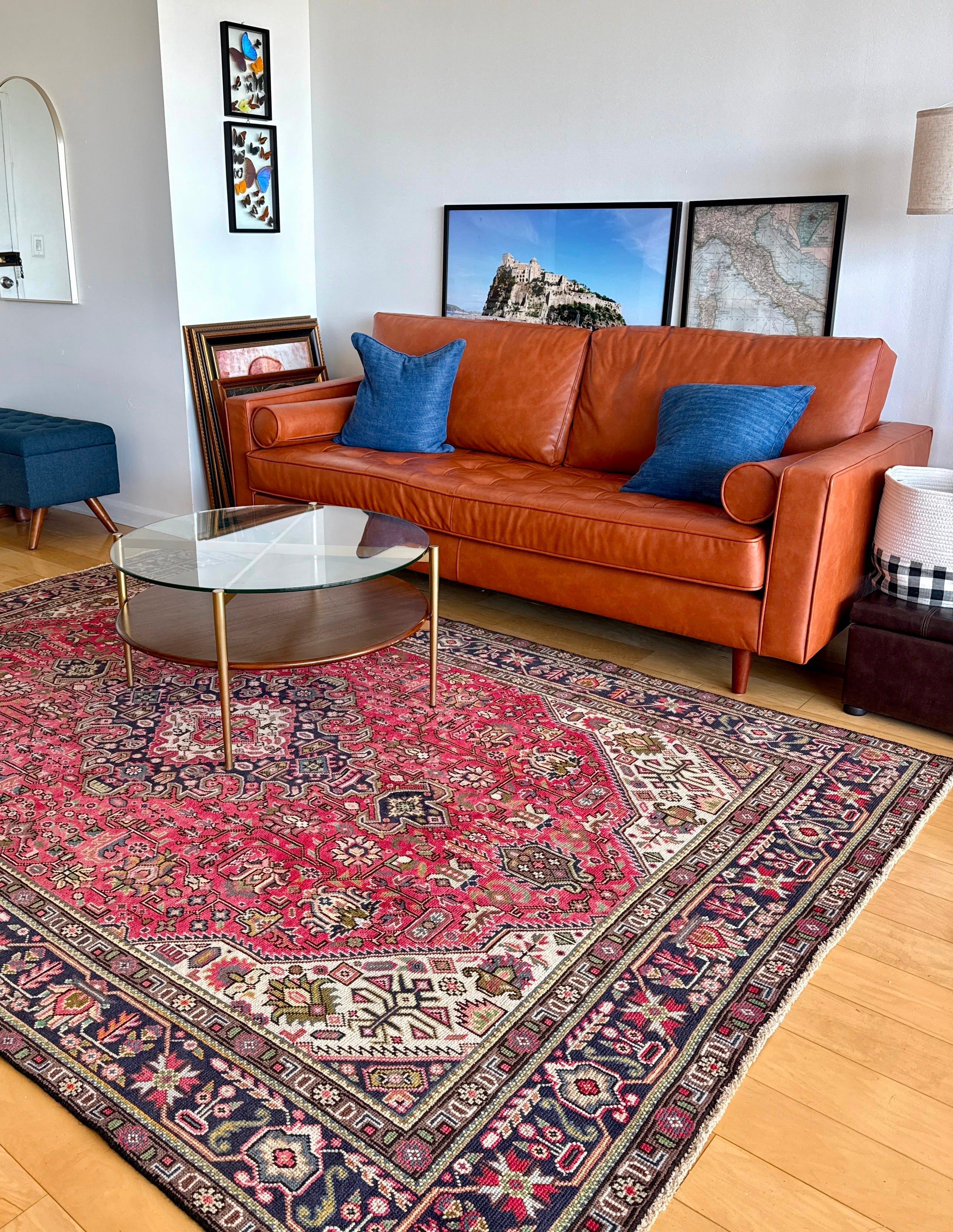
You know how Gen Z says “touch grass”? It means go do real things outside, away from your screen, because nature can truly put your mind and body at ease. I feel the same way about this carpet. Massoud, whose voice you hear in that podcast episode, said to me, “That’s because it’s nature.” He didn’t mean that it symbolizes nature with vines and geometric flowers, but truly that it is nature; made by hand, woven of sheep’s wool, and colored with natural dyes harvested in Iranian fields that right now, we can literally only dream about. It reminded me of Jackson Pollock’s famous declaration when another artist challenged him about why he didn’t work from nature: “I am nature.”
So before bed, I sit on my couch and stare at my carpet. Each night reveals something new to me and has helped me contemplate the words of Pope Leo, who just published an historic encyclical on Artificial Intelligence called Magnifica Humanitas, which means "magnificent humanity."
In my last podcast episode linked below — which had limited reach due to a technical issue — I spoke about the monastery of San Domenico in Naples, where St. Thomas Aquinas was writing the words that Pope Leo quotes in the encyclical. What Pope Leo and St. Thomas Aquinas both assert is the same lesson I’m getting from my Tabriz carpet — human creativity, reason, and craft are expressions of the divine.
Ep. 39: Location, Location, Salvation

In this episode, you'll learn why monasteries and convents were the engines of Italian culture for centuries, how Napoleon scattered their treasures across Europe, and why some of Italy's best hotels — and most important art museums — exist because of it.
This is why I will always encourage you to engage with art during your travels rather than viral trends. Listen to Vivaldi while you ride the vaporetto in Venice. Buy an antique bracelet or an old print as a souvenir instead of just a bottle of limoncello. Think about wine as a story of the land and the season, not a prestige item. Italy gives us so many opportunities to marvel at magnificent humanity.
Beautiful. Looking at carpets in renaissance paintings is among my favorite carpet hobbies. Check out the Holbein carpets.
I'm now going to be looking for Persian carpets in every painting I see.