


If you enjoyed this essay episode, you can subscribe for more at danielleoteri.com. If you're planning a trip to Italy and would like some expert guidance, book a consultation at danielleoteri-italy.com. And if neither of those is right for you but you'd like to show a little love, you can always buy me a coffee.
The most delicious thing you can eat in Southern Italy is buffalo milk mozzarella. Italy has earned such a sterling culinary reputation that most people just open their mouths and say yes to whatever is put in front of them. But every once in a while, someone says buffalo mozzarella, what the hell is that?
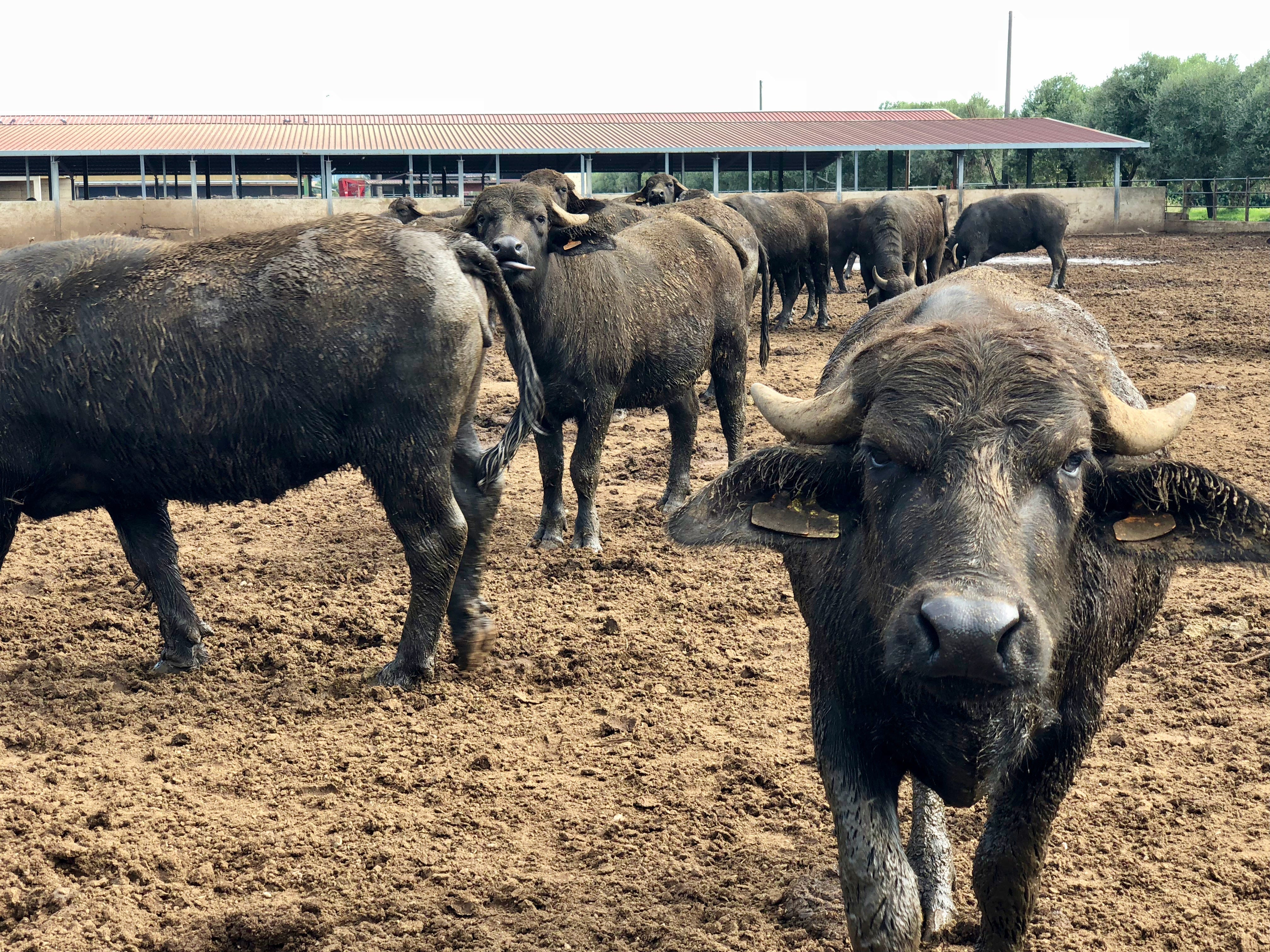
It is a strange thing to encounter, especially because the languid, enormous, but very sensitive water buffalo are cugini to the ones you’ll find in Vietnam or Cambodia, where buffalo milk mozzarella is not a thing. Buffalo mozzarella is made primarily in the region of Campania. It graces pizzas in Naples and has a different casein than most cow’s milk, so the lactose-intolerant among us can indulge. Buffalo farms abound in Caserta, near the stupendous Palace of Caserta, from where the Bourbon monarchy ruled over “the Kingdom of the Two Sicilies.” Before Italy became the nation we know it as today in 1861, it was a monarchy that pioneered several industries, including a dairy industry based on buffalo milk. But even more exquisite is the stuff made at a handful of farms, a little farther south.
If you’re driving there, maybe on a day trip from Naples or the Amalfi Coast, you’ll inevitably get snarled in traffic on what locals call “the mozzarella highway” through Battipaglia. Every sign on the roadside is flashing mozzarella di bufala. The traffic is largely due to hundreds of trucks that pass through daily to pick up mozzarella and transport it to supermarkets across Italy. I’ve heard waiters in Florence extol the virtues of its freshness, boasting that it just arrived in the restaurant that afternoon. I’ve also heard waiters in New York cooing that they just picked it up from JFK that morning. Keep driving; Battipaglia is an industrial farming zone, and everything is pasteurized for export. Better things await in the town called Capaccio-Paestum.
Paestum is most famous for three extraordinarily well-preserved Greek temples. They are massive and built of travertine, a volcanic stone, then coated in plaster and painted to mimic marble, which doesn’t exist in Southern Italy. Paestum was colonized by Greeks, conquered by Lucanians, who were the indigenous people of the area, whom the Greeks employed as their security goons, and then became a Roman city. Paestum was considered very old when the Romans conquered it. The oldest of the three temples was 280 years old. The Greeks regarded everything around the temples as sacred ground, but the Romans were insatiable real estate developers. There developed markets, civic buildings, a large Asclepieion, which was the closest thing to a hospital in the classical world, and dozens of smaller temples, all surrounding the big, very old ones.
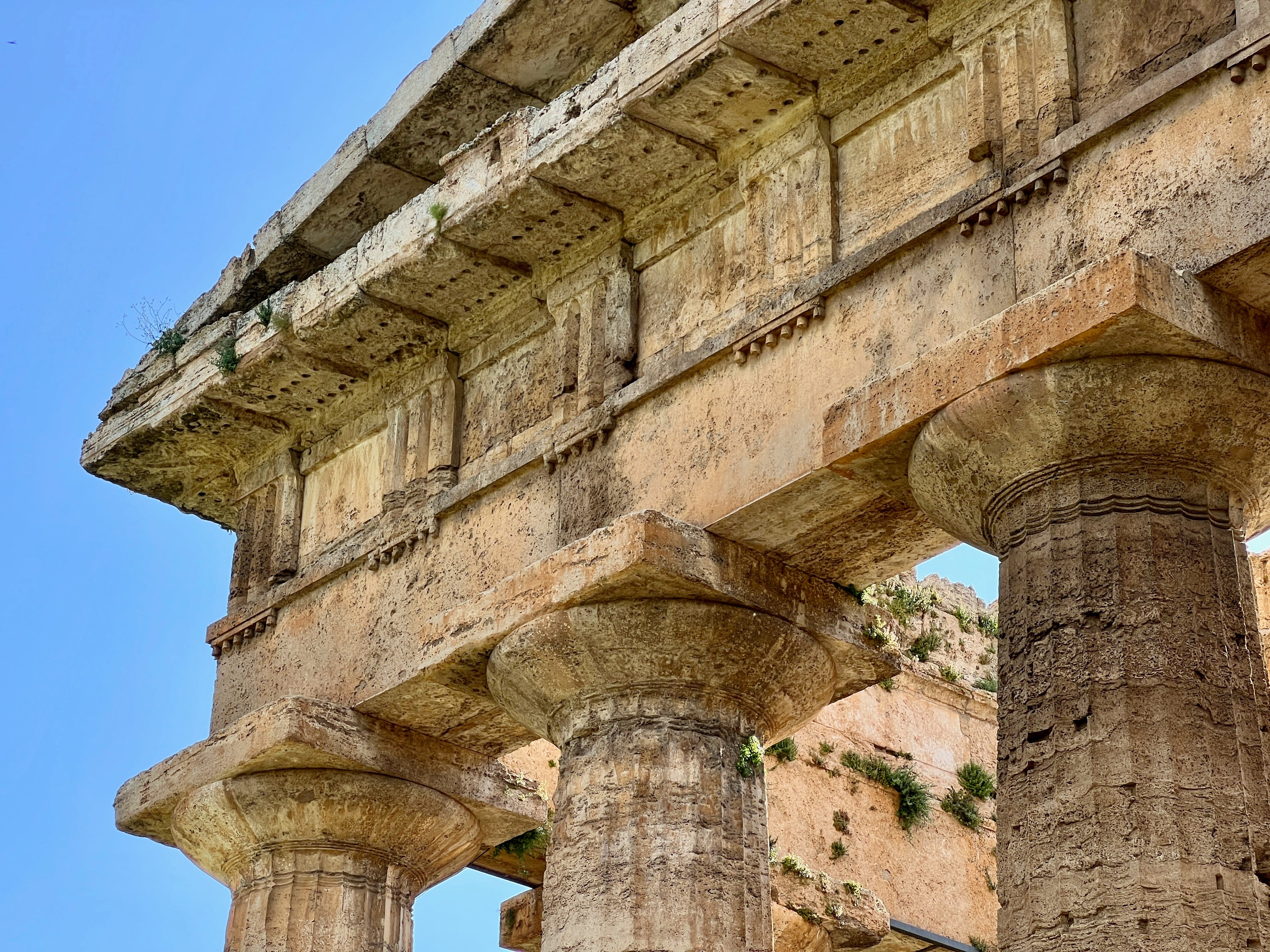
Roman Paestum was bigger and far more important than Pompeii or Herculaneum, and though it’s beyond the reach of Mount Vesuvius’s molten tentacles, it is still affected by earthquakes. The Roman Empire declined, and Paestum sank. Literally. The reason: a phenomenon called bradyseism, which is a Greek word: bradys means slow, and seismos means movement.” It’s an imperceptible but continuous slow rising and falling of the earth - a slow-motion earthquake.
When the Greeks built the temples close to the glittering Tyrrhenian sea, things were on the up. But by the third and fourth centuries, Paestum was a swamp, infested with malaria carrying mosquitos. Mal aria means ‘bad air.”
The Paestani fled for the hills. Some went to the hills just above Paestum, founding Capaccio, my grandmother’s hometown, while others went higher to the sea-facing cliffs of the Amalfi Coast. The name Positano may be related to the Paestani who settled there.
And certainly people also went to Salerno, which was a Roman city, then under Lombard rule, and in 1077 was officially conquered by the Normans, proud descendants of the Vikings, loosely related to the Normans who just 11 years earlier had taken England at the Battle of Hastings. Salerno was a luxurious city, full of international merchants, and home to the world’s first medical school. Meanwhile, once glorious Paestum, not very far away at all, must have looked like the zombie apocalypse.
Just to let you know, I haven’t forgotten we were talking about buffalo and delicious cheese; they will soon re-enter our story, but first, we need to make a stop in Salerno.
Salerno was where the Norman king built a cathedral dedicated to Saint Matthew the Apostle. It’s believed he died in either Ethiopia or Persia, but his bones somehow ended up near Paestum, and two people had a dream, alerting them to the location. They retrieved the old bones, and the cathedral was built around them. The Normans also began to adorn the area we now call the centro storico of Salerno with Roman columns from Paestum. They’re embedded in many corners, and sometimes you’ll see a sign with a dog lifting its leg and a red line across it. It may read “Questa e storia” - this is history, and don’t let your dog pee on it. The massive columns that you’ll encounter in the courtyard of the cathedral came from what must have been another enormous temple at Paestum, which was clearly functioning as an open quarry.
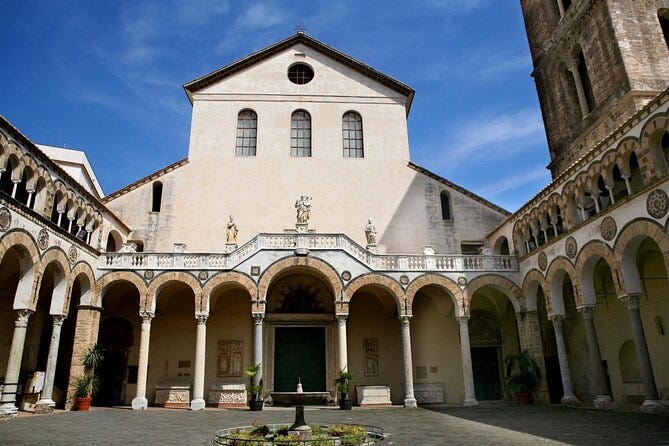
Why? Because using Roman columns made an architectural argument that the new power is heir to the Roman one. For someone from somewhere else, Northern France in this case, to frame himself as the legitimate successor to Roman caesars. And how did they physically pull them out of the swamp and drag them back to Salerno? With water buffalo, which are naturally immune to malaria.
Buffalo arrived on Italian soil via Arab merchants, who first brought them from Southeast Asia to Egypt for use as work animals. For roughly two centuries, Sicily was under Muslim rule, first governed by emirs from North Africa. Sicily was wealthy and well developed, so much so that the various wealthy factions dissolved into infighting, which allowed the Normans to more easily conquer them. Neither gentlemen nor scholars, they kept what the Arabs did best, including mathematics, agricultural practices, and sugary desserts, including cannoli. Buffalo thrived in the marshy lands along the Italian coast and were incredibly effective at doing the impossible work of clearing rivers. As they plod through streams, the underwater reeds that are nearly impossible for humans to remove will tangle around the legs of a buffalo sauntering through the day and easily snap and break.
Paestum doesn’t appear in the historical record again until the 1700s, during the period known as the Grand Tour. Part of a complete education was a trip to the Italian peninsula, where something astonishing had happened. Pompeii was discovered. The Bourbon kings of Naples not only founded the buffalo mozzarella industry, but also the field of archaeology, which didn’t exist. Pompeii fever swept the educated world and set off the Neoclassical movement. Paestum, though never completely abandoned, defined the word backwater, and was a more adventurous leg of the Grand Tour. In paintings from this period, you can see these beautiful Doric temples, their reflections in pools of water, and grazing buffalo all around them.
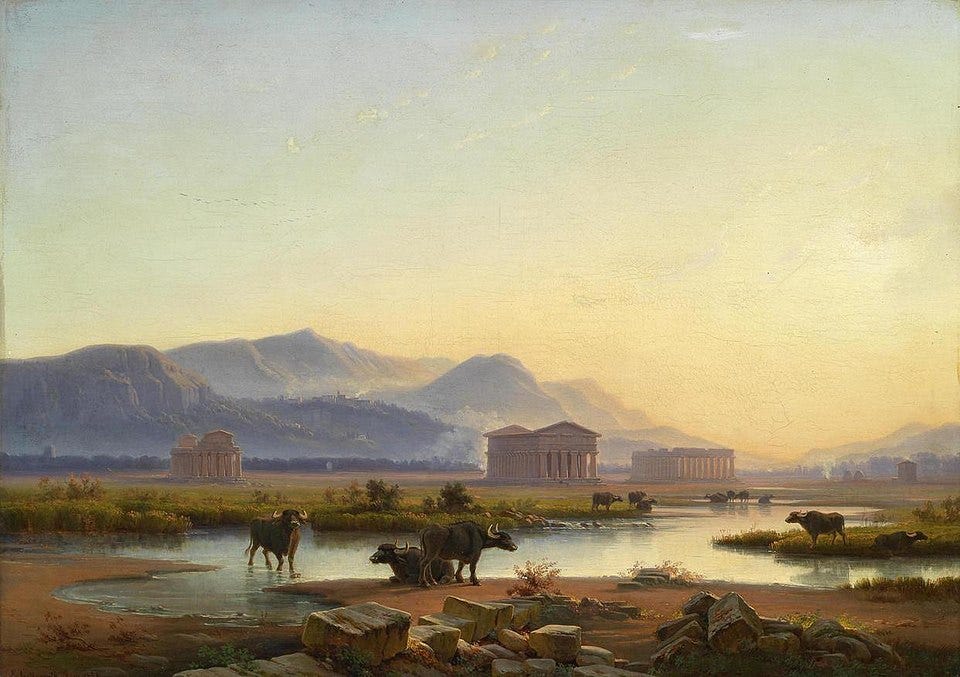
Can you imagine what a sight that must have been to citified elites from England and Germany? People who had never seen or even imagined a buffalo, or were accustomed to having their dopamine spiked by imagery hundreds of times every day?
In those paintings, you’ll also notice houses, and the locals – my ancestors – guiding the buffalo, or sitting on a hill wearing loose pants and a floppy hat, playing a flute, or some other peasanty activity. As a sidenote, I don’t understand how my lineage in this area survived long enough to produce me, as I am target number one on every mosquito’s agenda.
When you arrive at Paestum today, you will also find the very best farms producing buffalo milk mozzarella within a mile of the temples. Most well-reputed is Tenuta Vannulo, a local family-owned farm that has made artisanal cheesemaking and the highest standards of animal welfare a point of attraction. You can tour the facility and watch buffalo using state-of-the-art self-milking machines, getting massages with what look like car-wash brushes, while a guide explains how Mozart is played for them in their pens. The result is a product unlike anything on the mozzarella highway, and it is exquisite. I especially recommend the buffalo milk gelato. If you’re a coffee person, get the coffee flavor, drowned with a shot of espresso. (To the uninitiated, this is called an affogato.) That’s it, that’s the peak coffee experience of your life.
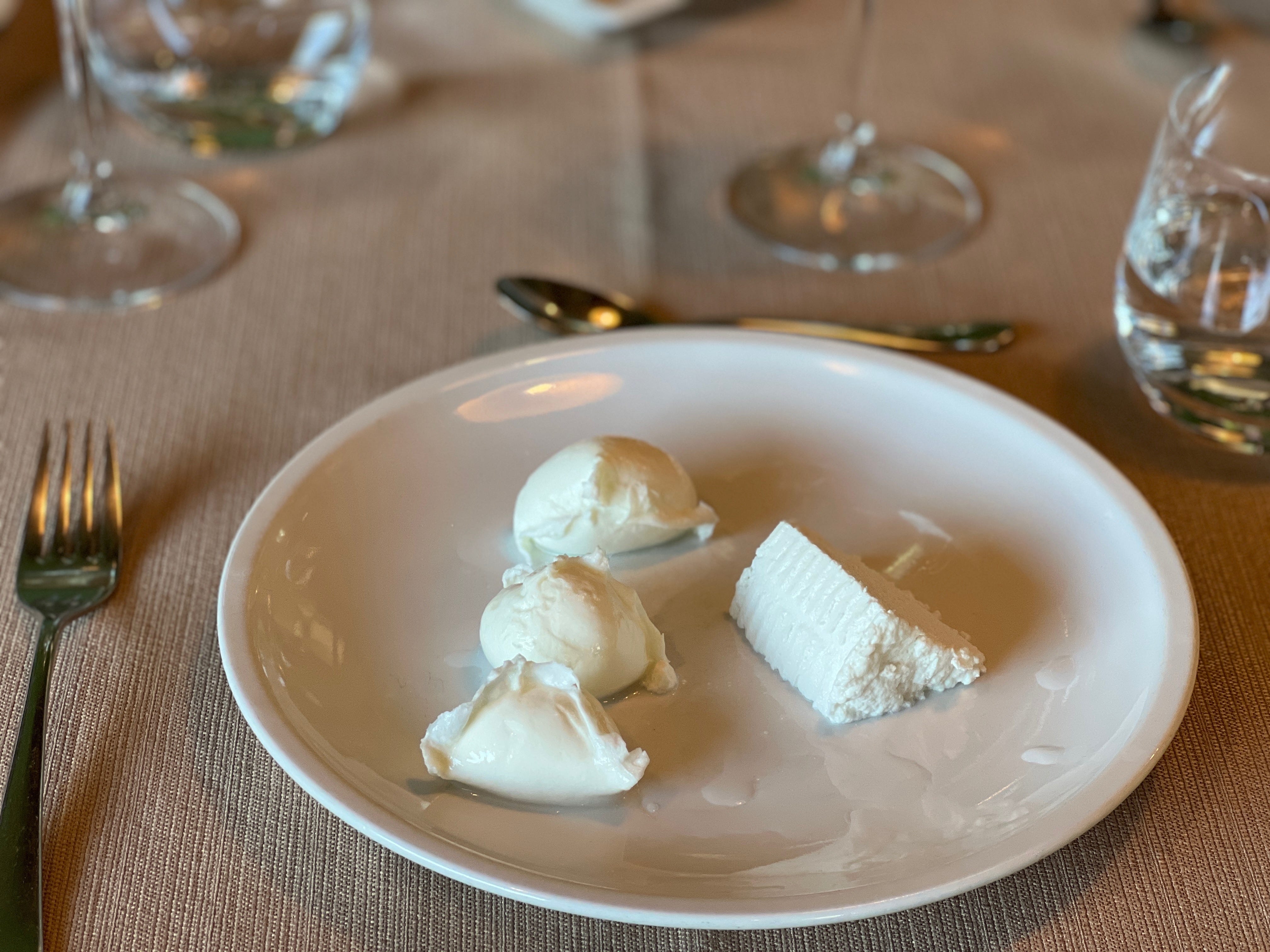
But my favorite place is Barlotti, partially because it’s within walking distance of the Paestum temples. You don’t have the full organized tour experience that you have at Vannulo, but you can hang out with the buffalo, who are very quiet and relaxed in a very Southern Italian way. Have lunch inside their beautiful glass-encased restaurant or in the garden underneath the pergola. Don’t overthink your menu choices. Get the sample plate that includes fresh mozzarella, smoked mozzarella, and a mound of ricotta, followed by a plate of cooked vegetables, a selection of whatever is growing at the moment. For dessert, a cannoli filled with buffalo milk ricotta.
After lunch, walk to the Paestum temples. The swamp was officially drained in the 1930s by the Fascists, another group that sought to legitimize itself by resuscitating Roman ruins, and the ground continues to be managed today. After the war, when malaria was eradicated, a modern Paestum was fully developed. If you walk on the right side of the road, you’ll see water running – there are ancient springs here, which certainly inspired the placement of the temples nearly 3,000 years ago. The presence of the Asclepieion, natural springs, and temples together indicates that the Greek colonists identified this as a place of healing. And you can squint past the sunlight and use your imagination to see a parade of buffalo, pulling a plough with a giant Roman column atop it, en route to Salerno. Because everything good from the old world should be used to build the new one.


