
If you enjoyed this essay episode, you can subscribe for more at danielleoteri.com. If you’re planning a trip to Italy and would like some expert guidance, book a trip consultation at danielleoteri-italy.com. Lastly, you can always buy me a coffee.
Guidebooks have several lives, and despite the internet, they have been diminished but are far from dead. That’s because they are among the only fact-checked pieces of travel material available. When you are paying for a guidebook, you are paying for knowledge. The transaction is clear.
Purchasing a guidebook is first a dream. It’s a catalog of possibilities. Then it becomes a strategic tool, a travel companion, and, when it returns home, either a beloved souvenir or totally useless. Often, people will hold on to them until they have to move or really clean and make space, and then Lonely Planet Prague has to go in the trash. And don’t even try to “donate” your 15-year-old guidebook; you know nobody wants it.
But guidebooks have another life if you hold on to them long enough. They become a time capsule — an eyewitness account that was also aggressively fact-checked about a world that no longer exists, that you can use to reflect on that world, and see just how much has changed.
That’s what has suddenly caused an essay I wrote in August of 2022 to go viral. It’s called “The Before Sunrise Generation,” and I wrote it in response to Gen X clients who were returning to travel now that their kids were leaving home and they had time and money to travel once again. They would ask if they should buy a Eurail pass or stay in a pensione, and I found myself explaining how the way they had traveled in the 1990s really no longer exists.
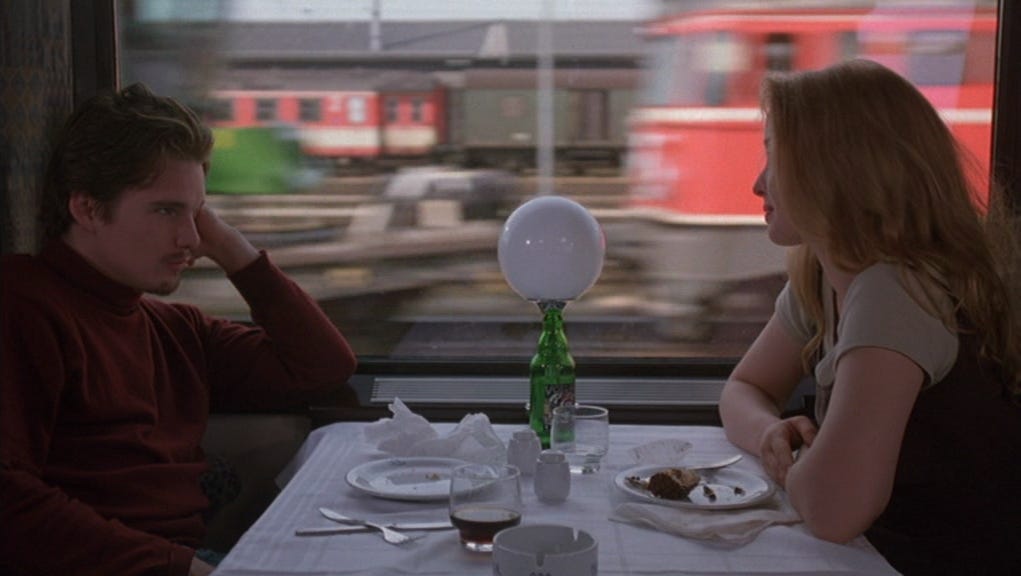
Then this current wave of 90s nostalgia — inspired by “Love Story,” about JFK Jr. and Carolyn Bessette — has the children of Gen Xers marveling at how free the 90s seemed. One hundred percent of social interactions were in real life, with total presence, nobody on their phone because they didn’t exist. Think about Jesse and Celine, the protagonists of the 1995 film Before Sunrise. They start talking while riding the train, and decide to get off together in Vienna, and spend the night wandering the city and talking. Nobody is tracking their location, and no photos are taken. Two strangers on a train, just figuring it out. If this movie were set in the present day, maybe they’d meet in line for a much-delayed Ryanair flight and maybe start talking only if they had been there so long their phone batteries died.
But the thing that today seems so old school and authentic at one point, the vulgar new thing.
We Will Simply Drift
Prior to rail travel, making the Grand Tour of Italy required private transportation, personal invitations, and letters of introduction. You had to be a person of means and education. Trains democratized travel. And then another industry emerged to meet that new tourist: the guidebook.
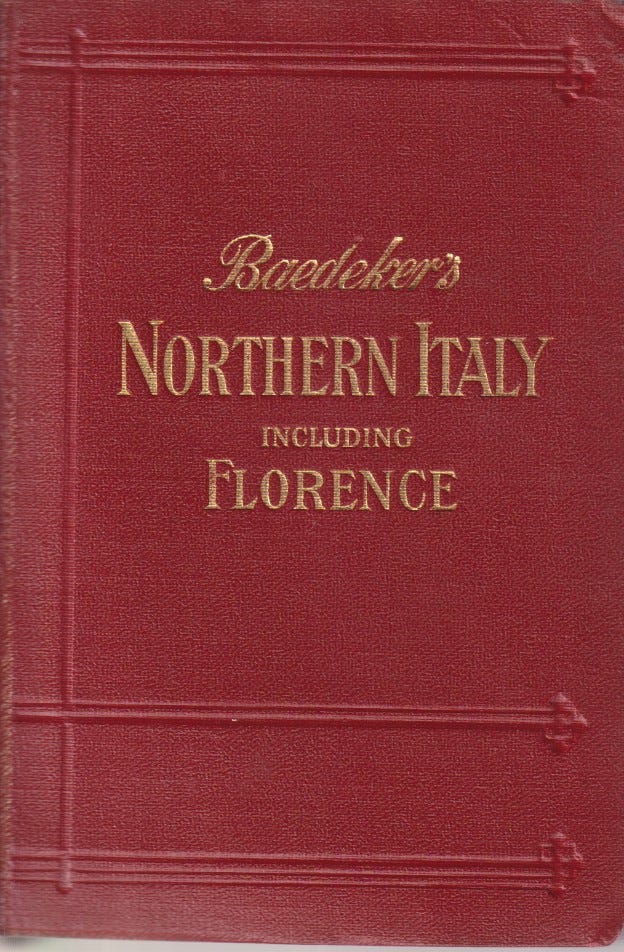
Baedeker guides, first published in Germany, were famous for their red cloth covers. They were comprehensive guides to cities and rural places, and they removed the need for a letter of introduction forever. They liberated people from relying solely on local guides who were only available to elite networks. The term “Baedekering” could be used with the same snark I sometimes reserve for TikTok tourism.
In E.M. Forster’s A Room with a View, “Baedeker” is a codeword for the pedantic sightseeing that Forster portrayed as typical of the English touring Italy. It’s funny that they were portrayed as kind of low-brow, because they were very dense with information on art and history, and were written by specialists. They were especially praised for their German precision, which was exactly what made them fall out of favor after World War II. German precision was uh, no longer a virtue.
Early in the story, Lucy is shown studying Baedeker’s Handbook to Northern Italy and committing “to memory the most important dates of Florentine history.” Later, she meets an eccentric lady novelist who disapproves of such solemnity and tells her, “No, you are not to look at your Baedeker. We will simply drift.”
Overtourism in 1909?
The author Henry James was not a fan of the new train-traveling tourist. In 1909, he wrote Italian Hours, where he decried that Venice was overrun by tourists, totally devoid of authenticity — that the sentimental tourist’s sole quarrel with his Venice is that he has too many competitors there. He likes to be alone, to be original, to have — at least to himself — the air of making discoveries.
Just as I can be very eye-rolly about TikTok tourism, those who had experienced the Grand Tour were disgusted by the overtourism that proliferated in the 1890s.
I have been saying for a while that, because of technology, those of us born pre-Y2K have witnessed an accelerated period of time in which technology has changed more quickly than anything else in history. But Ada Palmer, the author of the fantastic book Inventing the Renaissance: Myths of a Golden Age, articulated this in an interview, where she said people in the 1310s were nostalgic for the way it was in the 1300s, and there has always been upending innovation, even if we look back and don’t find the innovation particularly interesting. Chairs with backs, different kinds of metallurgy… people are always innovating.
Naples in the Nineties
But I fully confronted my self-important idea when I opened an old guidebook called Naples in the Nineties —about the 1890s.
The first chapter is called “Vanishing Naples.” The author, a British consul to South Italy, wrote a survey of Naples and the surrounding area for travelers. He speaks most about Naples as a place to see the last of the old world: superstitions fading, religious practices disappearing, a pre-industrial way of life giving way.
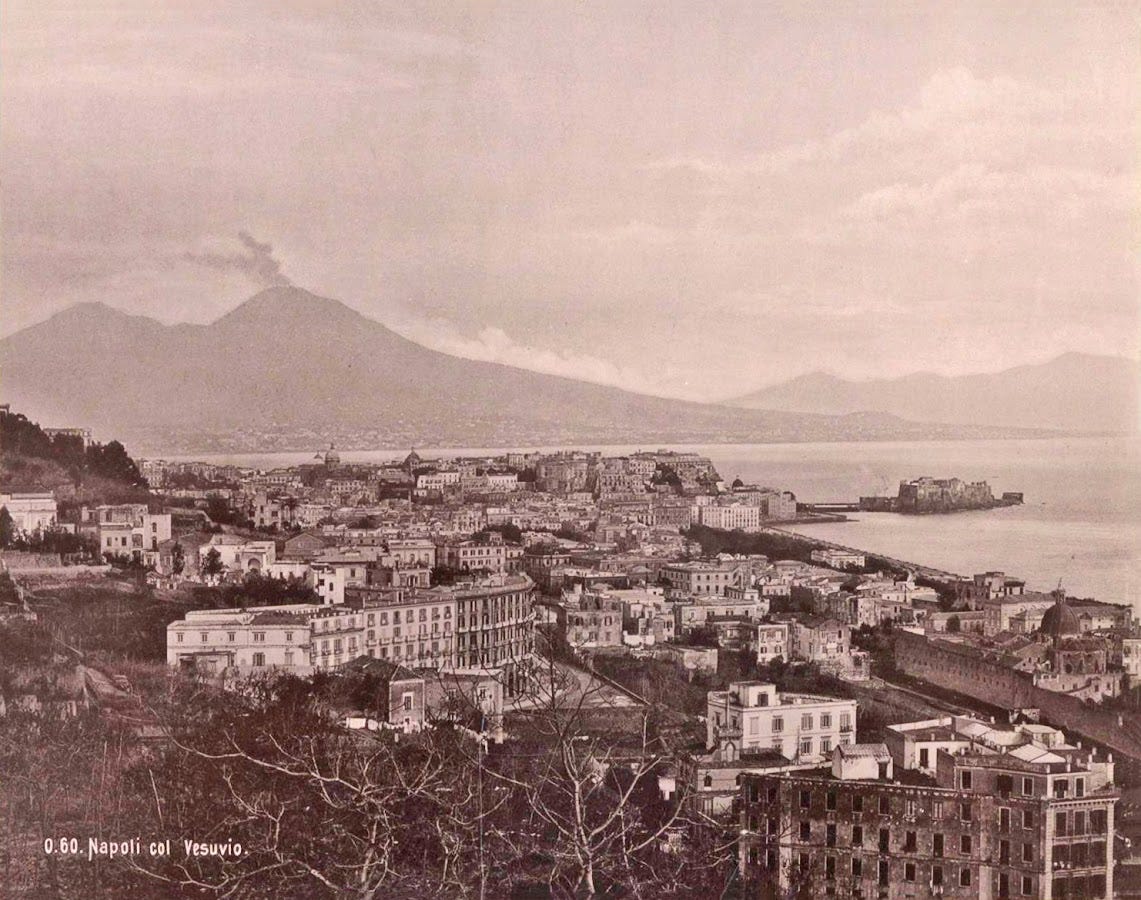
Naples had been the capital of the Kingdom of the Two Sicilies — a monarchy — that ended with Italian unification in 1861. This was to be a good thing, economically, for everyone, but of course, nobody had any idea how much more change was barreling toward them.
The 1890s were the heart of the second industrial revolution, which came later to Italy because the Italian peninsula had always had such a robust agricultural economy — really since the Roman Empire — that it didn’t need to industrialize until it was absolutely forced to.
The monarchies of pre-modern Italy fell when Italy unified as a modern nation in 1861. Wealth consolidated in the north, with an industrial corridor developing between Milan, Turin, and Genoa. Add in harsh taxation, and Southern Italy went into economic free fall. The result was mass emigration. Cheap labor for the northern factories, plus financial support from family working abroad, helped Italy fully industrialize.
The damage to the south had begun long before Italian unification, with the industrialization of wool production. The wool and olive oil trade had fueled the Renaissance and sustained the economy of southern Italy for centuries. The Medici and the great banking houses of Florence built their wealth on wool, and the whole system ran on transhumance, the twice-yearly migration of massive sheep herds along ancient grass paths called tratturi, from the highlands of Abruzzo down through Molise to the plains of Puglia. Shepherds had been following these routes since the 3rd century BC. The families who owned the flocks built the great palaces you still find in the mountain towns of Abruzzo. Then, the first phase of the industrial revolution at the turn of the 18th century gutted the wool market. British industrialization mechanized textile production, collapsing cloth prices, and eliminating the economic reason to maintain the herds.
In the 1890s, many of these rural places in Italy collapsed. Naples, chaotic and changeable, was wobbling through it.
Eustace spends much of his book discussing the wearing of amulets and the belief in spirits and spells, which are also disappearing. He catalogs the amulets people wore to keep away evil spirits: the mermaid, the seahorse — objects that would keep away the bad air that brought cholera and also malaria. The 1870s and 1880s saw terrible cholera outbreaks across Italy, spread by standing water, an easy fix that was finally resolved in the 1890s. Better sanitation diminished superstition. The mermaid is still a symbol of Naples, but you won’t see it as an amulet to ward off the bad air. You will see the cornicello, though — a little red horn. It’s everywhere in Naples: on keychains and dashboards and restaurant walls. It transformed from a tool to a symbol of identity.
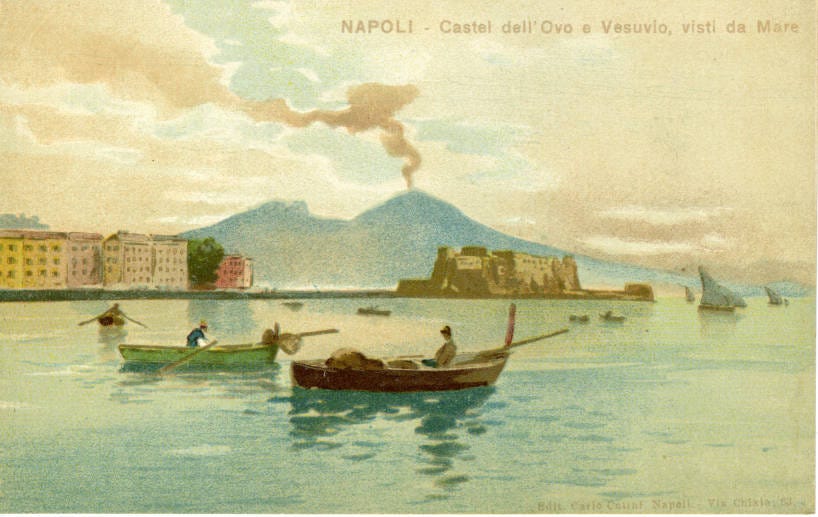
And what’s interesting is that even though so much has changed, the descriptions aren’t that different from what you’ll experience today, which is really fascinating commentary on how the spirit of a place can persist. Henry James in Italian Hours described the waterfront of Naples, the lungomare, its lazzaroni, its peasants fishing on the waterfront, and the general air of beauty and chaos. Now it’s pedestrianized, lined with hotels and restaurants, but still chaotic in that Neapolitan way — full of life. You’ll still see locals with their fishing poles in the water, right next to the port where the cruise ships dock and where millions of Italians once departed for lives abroad. It’s completely different and yet completely the same.
The Loss of the Picturesque
Naples in the Nineties emphasizes much of the advice I pass on today. Go to Ischia. Visit the ruins at Baia. Go see the stadium in Capua, which is like seeing the Colosseum, except that there will only be you and an older Belgian couple visiting. (Every archaeological site in Italy has one Belgian couple visiting. I don’t know who writes their guidebooks, but they must be good people.) Yes, Capri is full of beauty, but hardly any Caprese live there anymore because the expats have taken over. Yes, that was what he said in 1897!
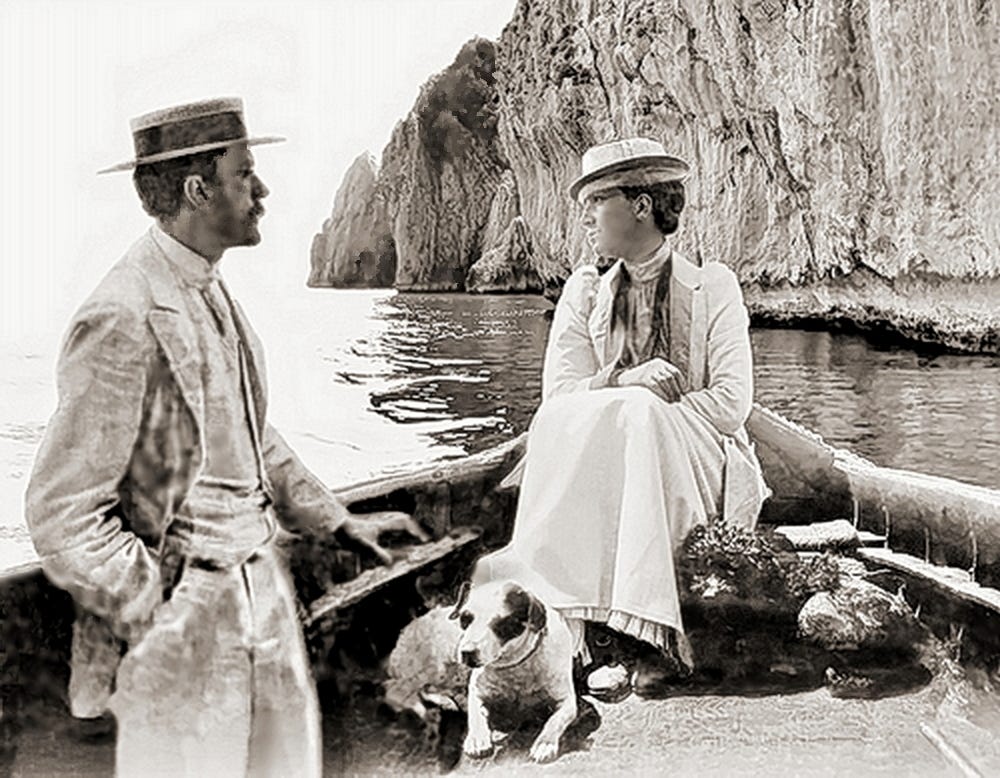
He discusses Torre del Greco and how coral supplies have diminished; the fishermen now have to go all the way to Sicily, where they find far inferior coral, yet they are still selling cameos there. One hundred and thirty years later, they are still selling cameos there because the craft has survived.
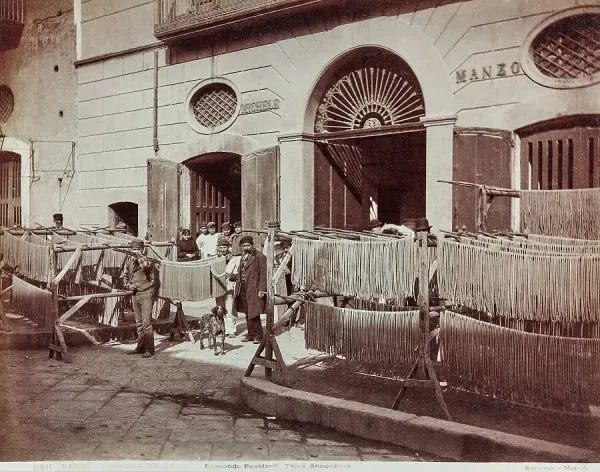
And Torre Annunziata, he recommended trying macaroni, since all the pasta factories are there. He writes: “The principal industry of the town is macaroni making, which may be seen here in great perfection on application at any of the mills. Until recently, it was supposed that macaroni, like wine, could only be made by manual labor. The skill of modern engineers has shown this notion to be fallacious, and macaroni is now almost universally made by machinery and is not at all inferior to that made by the old-fashioned plant. We have, of course, a loss of the picturesque, but we are learning to bear this loss with the serenity acquired by habit.”
How many times have I tried to frame a photo to block out the electrical wires, or looked for a Vespa or an old Fiat to anchor my shot instead of the more ubiquitous Toyota Yaris? In many ways, tourism is the biggest thing protecting the picturesque. Nobody wants to go on a food tour that takes you to Conad or Edil.
Here’s a detail I just loved — Eustace notices “the public writers at their tables in the streets, fewer of them now, their business decidedly slacker than it was in the old days.” These “scrivani” were people who served the illiterate: filling out documents, writing letters to relatives abroad, and also frequently writing love letters.
The post office was putting them out of business by centralizing bureaucratic operations. The scrivano, who had been the human interface between the illiterate citizen and the written world, was being replaced by an institution.
Their Business Decidedly Slacker
When I was traveling in 2001 and 2002, I used internet cafés the same way — once every few days, you’d buy an hour, log into your Yahoo or AOL account, and check emails that were still being written like letters. The smartphone erased the need to make the time and spend the money, and now AI empowers anyone to be completely uninhibited in their written expression in any language.
And speaking of AI, Eustace also writes about Herculaneum, buried alongside Pompeii in 79 AD. He describes the discovery of the Villa of the Papyri, originally called “the house of the coal merchant” because of the carbon fragments found there. Later, they discovered those pieces of carbon were charred rolls of papyrus. An entire Roman library, carbonized by the eruption.
He writes: “There is no saying what literary treasures this library may not contain. Hitherto nothing of the first importance has been found, the works being chiefly philosophical, but there is every reason to hope that a wealthy man’s library, contained in 79 AD, may contain many works which have been lost to the world.”
Going Very Rapidly Indeed
He wrote that in 1897. Those same scrolls — still unreadable for over a century because they crumble the moment you try to open them — are now being decoded by AI. The Vesuvius Challenge, a project that used machine learning to read the carbonized papyrus without physically unrolling it, has already recovered text. We may yet find out what was in that library.
Eustace couldn’t have imagined it. Neither could I, really, until it happened.
As someone who attended both high school and college in the 90s, the internet just seemed to happen. We had Prodigy, then AOL, and Instant Messenger, but they all seemed like new toys for about ten years, until everything rapidly digitized in the early aughts. It’s funny, because I feel like I saw the end of the old world in Florence in the 90s, when there were still little shops on the side streets with nothing more than a pot of hot oil and an older woman frying things in it. And I yearn for that again as I see people feel morally obligated to stand in line for viral sandwiches inspired by social media.
He closes the chapter: “If we have dwelt at some length on Naples from the old world point of view, it is because we love her best clad in her old garments… but we need not blind ourselves to the fact that all this must go. Naples is going very rapidly indeed.”
I opined in my Before Sunrise essay that the internet democratized meticulous planning, but it annihilated spontaneity.
But the lesson from Eustance is: We are learning to bear this loss with the serenity acquired by habit.
We are always witnessing the end of something and the beginning of something.